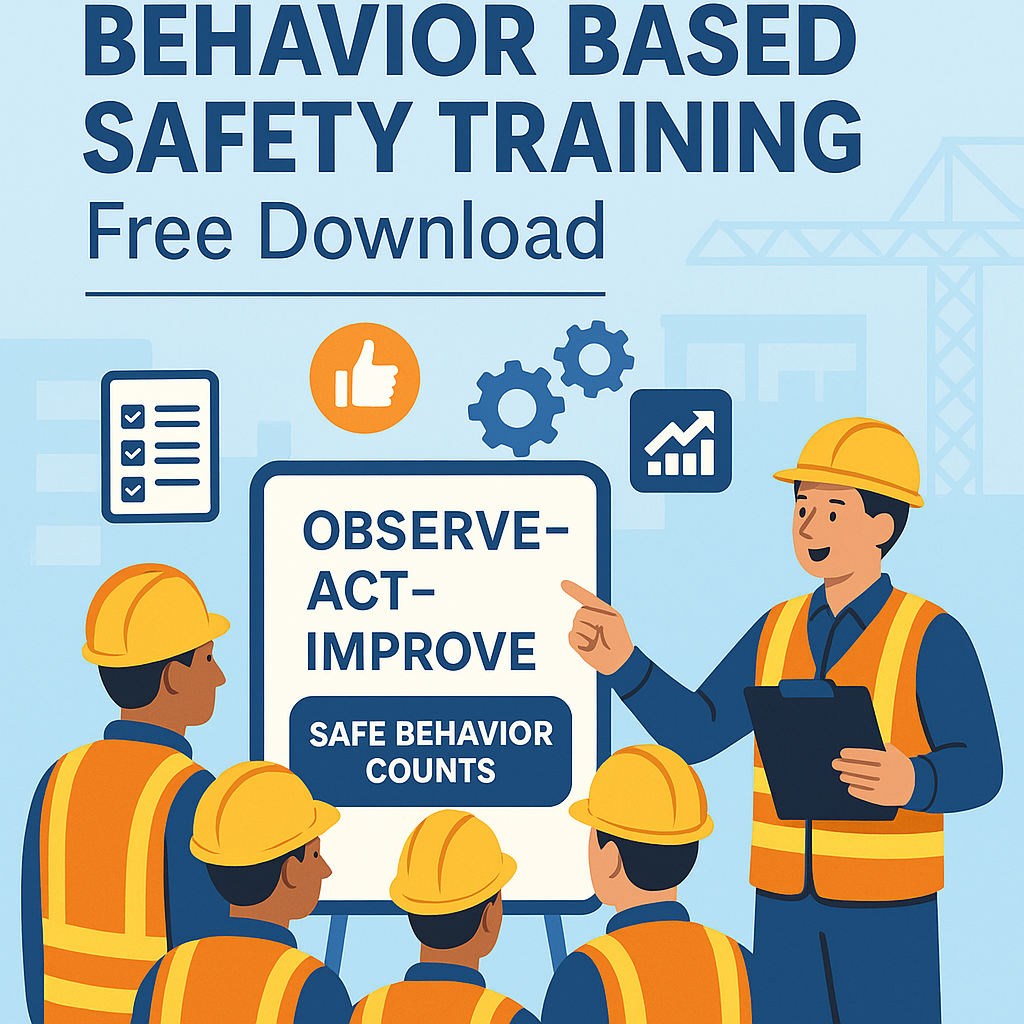
Behavior Based Safety Training – Free Download
Introduction – Greeting Your Trainees
Good morning everyone. My name is ________, and I am your Safety Officer.
Today, we’re going to discuss one of the most powerful tools for preventing workplace incidents — Behavior Based Safety (BBS).
BBS focuses on why people behave the way they do at work and how we can influence those behaviors to prevent injuries and promote a positive safety culture. Instead of just relying on rules or equipment, BBS helps us understand the human side of safety.
By the end of this session, you will learn:
- What Behavior Based Safety means.
- How to observe, record, and analyze unsafe acts.
- How to give constructive feedback.
- How to build a culture where safe behavior becomes a habit, not a rule.
1. What is Behavior Based Safety (BBS)?
Behavior Based Safety is a systematic process that identifies and reinforces safe behaviors while discouraging unsafe ones. It relies on employee observation, feedback, and participation to improve safety performance.
The main idea: “Most accidents are caused by unsafe acts rather than unsafe conditions.”
2. Objectives of BBS
- Reduce workplace incidents caused by human error.
- Promote self-awareness and peer accountability.
- Develop a positive safety culture through observation and feedback.
- Strengthen communication between workers and management.
3. The ABC Model of Behavior
BBS is based on the ABC Model:
| Component | Meaning | Example |
|---|---|---|
| A – Antecedent | Trigger or event that leads to behavior. | “Hurry to meet deadline.” |
| B – Behavior | Action taken by the person. | “Worker climbs without harness.” |
| C – Consequence | Result that follows behavior. | “Supervisor praises for speed.” |
Changing behavior means modifying antecedents and consequences to encourage safer actions.
4. Core Principles of BBS
- Focus on behavior, not attitude.
- Observation is non-punitive.
- Participation is voluntary and respectful.
- Feedback is immediate and constructive.
- Data drives improvement.
5. Why BBS Matters
Even with strong engineering controls, incidents still happen because of unsafe decisions. BBS helps bridge the gap between systems and people by identifying at-risk habits and replacing them with safe ones.
6. Unsafe Acts vs Unsafe Conditions
Unsafe conditions are hazards in the environment. Unsafe acts are choices people make that increase risk.
BBS focuses on acts such as:
- Not wearing PPE.
- Taking shortcuts.
- Ignoring lockout/tagout.
- Failing to use handrails.
7. Key Roles in a BBS Program
| Role | Responsibilities |
|---|---|
| Management | Provide support, resources, and training. |
| Supervisors | Encourage participation and model safe behavior. |
| Observers | Conduct observations, record data, and give feedback. |
| Employees | Accept feedback and commit to safe actions. |
8. Observation Process
A cornerstone of BBS is observation.
Steps:
- Identify the task and worker.
- Observe behaviors discreetly.
- Record safe and unsafe acts.
- Provide constructive feedback immediately.
- Submit observation data for analysis.
9. Feedback Techniques
- Start positive: Acknowledge safe behaviors first.
- Address unsafe actions calmly.
- Focus on the act, not the person.
- Discuss why the behavior occurred.
- End with mutual agreement on improvement.
10. BBS Observation Checklist Example
| Behavior Category | Safe | Unsafe |
|---|---|---|
| PPE Usage | ✔ | ❌ |
| Use of Tools | ✔ | ❌ |
| Housekeeping | ✔ | ❌ |
| Body Position | ✔ | ❌ |
| Following Procedures | ✔ | ❌ |
Use this checklist to record observations and identify trends.
11. Encouraging Participation
Workers are more likely to engage when they:
- See management involvement.
- Receive appreciation for safe acts.
- Understand that feedback is non-punitive.
- Are recognized for improvement.
12. Building Trust
Trust is the foundation of BBS.
If workers fear punishment, they hide unsafe acts. When trust exists, they report hazards openly, leading to long-term cultural change.
13. Data Collection and Analysis
Observation data should be entered into a database to identify trends:
- Frequent unsafe acts.
- High-risk areas.
- Recurrent issues by shift or team.
Use this data for training, engineering improvements, and coaching.
14. Behavior Reinforcement
Encourage and reward safe behaviors through:
- Positive recognition.
- Verbal praise.
- Incentive programs.
- Safety awards.
Reinforcement turns safe acts into habits.
15. Removing Barriers to Safe Behavior
Common barriers:
- Time pressure.
- Lack of tools or PPE.
- Poor procedures.
- Low morale.
Supervisors should identify and remove these barriers to support BBS success.
16. Integrating BBS with Safety Management Systems
BBS should complement—not replace—existing systems like:
- Permit to Work (PTW)
- Risk Assessments
- Safety Audits
- Safety Committees
Together, they create a holistic safety culture.
17. Supervisor and Management Commitment
Leaders must “walk the talk.” When managers demonstrate safe behavior and attend observations, workers follow suit.
18. BBS Observation Frequency
- Routine tasks: Observe weekly.
- High-risk tasks: Observe daily.
- New teams or contractors: Observe during first week of work.
19. Handling Resistance
Resistance is natural. Address it by:
- Listening to concerns.
- Explaining benefits.
- Sharing success stories.
- Ensuring no blame or penalties.
20. Communication and Feedback Loops
Share results through:
- Monthly BBS reports.
- Team meetings.
- Notice boards or dashboards.
Transparency motivates teams to maintain performance.
21. Using BBS Data for Continuous Improvement
Analyze observation data to revise training, modify procedures, and plan interventions where unsafe acts are frequent.
22. Linking BBS with Performance Appraisals
When appropriate, include BBS participation in performance metrics—emphasizing improvement, not punishment.
23. Case Studies and Lessons Learned
Case 1:
An oil refinery introduced BBS and reduced hand injuries by 60% in six months.
Lesson: Feedback-driven culture can transform performance.
Case 2:
A contractor team resisted BBS initially. After management participation, unsafe acts dropped by 40%.
Lesson: Leadership involvement drives success.
24. Common Mistakes in BBS Implementation
- Treating BBS as a fault-finding tool.
- Focusing on paperwork instead of behavior.
- Lack of management follow-up.
- Not sharing results with the workforce.
25. Success Factors
- Strong management support.
- Trust and transparency.
- Frequent feedback.
- Recognition of positive behavior.
- Integration with existing safety systems.
26. Summary and Key Messages
- Behavior Based Safety focuses on actions, not attitudes.
- Observe, record, and give positive feedback.
- Encourage safe habits through reinforcement.
- Build trust—avoid blame.
- Use data for continuous improvement.
Behavior Based Safety turns safety from a rulebook into a shared mindset.
Download the PDF
For more checklist and Templates visit The HSE Tools.
Contractor Safety Management Training Free Download
Excavation Safety Training Free Download
Machine Guarding Safety Training Free Download
