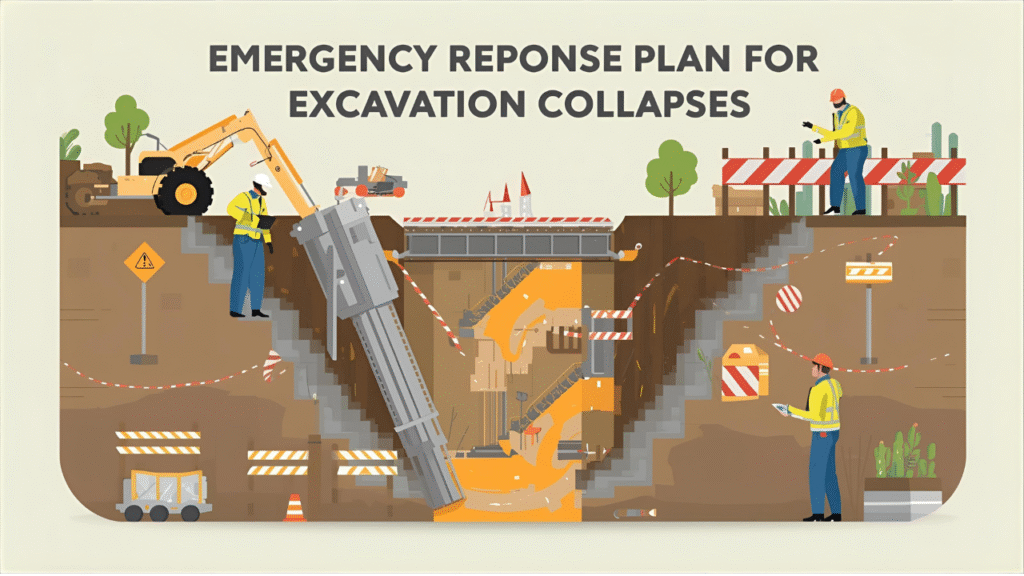
Emergency Response Plan for Excavation Collapses
An excavation collapse happens suddenly and without warning. It is the most dangerous emergency scenario in trenching operations because workers can become buried under thousands of kilograms of soil in seconds. As the survival window is incredibly narrow — often less than 5–10 minutes — a well-designed emergency response plan can be the difference between life and death.
This article explains how organizations should prepare for excavation emergencies, how to respond to collapses safely, and how to conduct rescue operations without creating secondary accidents.
Understanding the Severity of Excavation Collapses
A cubic meter of soil can weigh over 1,500–2,000 kg — roughly the weight of a small car. When a trench wall collapses, soil pressure can:
- Crush organs
- Suffocate trapped workers
- Cause internal injuries
- Paralyze limbs
Even shallow trenches can trap workers fatally.
Goals of an Emergency Response Plan
Primary Objectives
- Protect rescuers
- Save trapped workers
- Prevent secondary collapses
- Establish communication
- Secure site and preserve evidence
Secondary Objectives
- Initiate post-rescue medical response
- Document incident
- Conduct root-cause analysis
Pre-Emergency Preparedness
Before any excavation work begins, emergency readiness must be established.
Key Preparations
- Identification of emergency exits
- Rescue equipment availability
- Communication systems checked
- First-aid resources on-site
- Emergency drills conducted
- Trained rescue personnel designated
Emergency Team Designation
Organizations should assign:
- Site emergency coordinator
- Rescue team leader
- First aid responders
- Equipment operators
- Communication officer
Everyone must know their role in the event of a collapse.
Essential Rescue Equipment for Excavation Sites
Each site must have:
- Stretchers
- Cervical neck braces
- First-aid trauma kits
- Ladders
- Shoring equipment
- Ventilation blowers
- Oxygen kits
- PPE for rescuers
- Gas detectors
- Radios & communication gear
- Excavator on standby for soil removal
The equipment must be regularly inspected and accessible.
Emergency Response Procedure (Step-by-Step)
When a collapse occurs:
1. Stop All Work Immediately
Actions
- Equipment operators stop machinery
- All personnel move away from trench
- Safety alarms activated
Important:
Do NOT attempt immediate digging by shovel or machine without control — it may cause further collapse.
2. Alert and Notify
Types of notifications
- On-site emergency responder
- HSE officer
- First-aid team
- Local emergency services (if required)
- Supervisory management
Workers must use:
- Whistles
- Air horn
- Radio codes
Clear communication is critical.
3. Secure the Site
Actions
- Stop unauthorized access
- Mark hazard perimeter
- Install barriers or caution tape
- Clear loose materials from trench edge
Secondary cave-ins pose danger to rescuers.
4. Assess the Situation
Competent person evaluates:
- If additional collapse is likely
- Number of workers trapped
- Depth of burial
- Equipment accessibility
- Soil stability
No rescue begins until assessment is completed.
5. Stabilize the Trench (If Possible)
Shoring or stabilization is required before excavation begins.
Methods
- Install hydraulic or timber shoring
- Use trench shields to protect rescuers
- Create safety access routes
Unstable soil must not be disturbed.
6. Begin Controlled Rescue Operation
Rescue sequence
First priority:
Preserve airway & breathing of trapped workers
Then:
- Remove soil slowly and systematically
- First uncover head and upper torso
- Avoid sudden release of pressure on the body
Sudden decompression of trapped limbs can cause shock.
7. Provide Immediate First Aid
For partially buried workers
- Maintain open airway
- Stabilize head and neck
- Administer oxygen if needed
- Treat for shock
- Monitor breathing
For fully buried workers
- Medical team prepared for likely:
- Asphyxiation
- Trauma
- Crush syndrome
- Internal injury
8. Transfer to Medical Facility
Once extracted:
- Place on stretcher
- Immobilize neck and spine
- Maintain oxygen
- Transport quickly
Time is critical.
Crush Syndrome — A Specific Excavation Risk
When body parts are compressed for long durations, muscle tissue breaks down, releasing toxins into the bloodstream. Releasing pressure suddenly can lead to:
- Kidney failure
- Cardiac arrest
Prevention
- Medical supervision during rescue
- IV fluids if required
- Controlled release of soil pressure
Communication Protocols
Communication is critical during rescue.
Communication priorities
- Assign one radio channel for emergency only
- Avoid panic or unclear orders
- Use short, standardized messages
- Confirm instructions verbally
Example:
“Rescue Unit One moving in — Confirm trench wall safe?”
Training Requirements for Workers and Supervisors
Workers must be trained to:
Recognize warning signs
- Cracking soil
- Bulging walls
- Water seepage
- Falling gravel
Act immediately
- Stop work
- Evacuate
- Report hazard
Understand rescue limitations
Workers must never attempt rescue alone.
Post-Incident Actions
After rescue is complete:
Incident Reporting
- Detailed documentation
- Witness statements
- Photographs
- Soil conditions recorded
Site Investigation
A root-cause analysis identifies:
- Soil instability
- Lack of protection
- Inadequate shoring
- Overloading
- Human error
Corrective Measures
- Revised procedures
- Additional training
- Updated PTW requirements
Reasons Rescues Often Fail
Common Mistakes
- Untrained workers attempt recovery
- Excavator digs too aggressively
- Soil pressure not stabilized
- Panic leads to disorder
- Lack of equipment
- No emergency planning
A poorly managed rescue can kill rescuers.
Legal Responsibilities
Employers must:
- Provide protective systems
- Train workers
- Implement emergency plans
- Assign competent person
Supervisors must:
- Conduct daily inspections
- Stop unsafe work
Workers must:
- Follow rules
- Report hazards
Failure to comply can result in:
- Criminal penalties
- Civil lawsuits
- Operational shutdown
Best Practices to Avoid Fatalities
Before collapse happens
- Use sloping or shoring always
- Keep heavy loads away from trench
- Install safe access routes
- Check soil moisture
- Do not work alone
During rescue
- Safety of rescuers first
- Work methodically
- Never rush
After rescue
- Provide psychological counseling
Witnessing trench fatalities is traumatic.
Conclusion
An excavation collapse is one of the most severe emergencies in construction work. The speed of response and the quality of planning determine survival outcomes. A well-established emergency response plan — supported by trained personnel, proper communication, adequate equipment, and disciplined rescue protocol — is essential. Excavation emergencies must never be handled spontaneously — they must be practiced, structured, and controlled.
Preparedness saves lives. Panic kills.
For checklist and templates visit The HSE Tools.
Daily Excavation Safety Checklist for Supervisors
Permit to Work System in Excavation Activities
Shoring, Sloping and Benching: Protective Systems Explained
Soil Classification and Testing for Excavation Safety
Excavation Hazards and Their Control Measures
FAQs
1. How fast must response start after collapse?
Immediately — rescue efforts should begin within seconds, but safely and systematically.
2. Should untrained workers attempt rescue?
No — rescue must be performed by trained personnel only.
3. Why is trench stabilization necessary before rescue?
To prevent secondary collapses that kill rescuers.
4. What is the most common cause of excavation death?
Asphyxiation and crush injury due to soil pressure.
5. Who leads rescue operations?
The designated competent person or appointed emergency coordinator.
