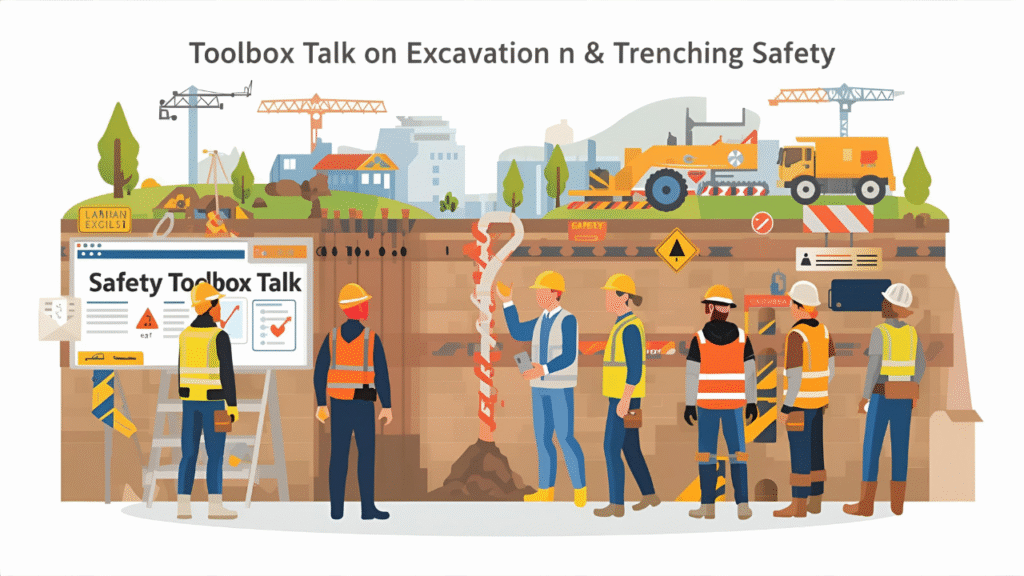
Toolbox Talk on Excavation and Trenching Safety
This toolbox talk is designed for safety officers, supervisors, and crew leaders to deliver a practical, on-site safety briefing about excavation and trenching hazards. Workers often underestimate the dangers present in trenches. Many assume that “it won’t happen to me,” until a collapse or accident happens.
A trench collapse can bury a worker in seconds — with soil equivalent to thousands of kilograms of crushing pressure. Without training and proper protective systems, excavation work can quickly turn fatal.
This talk ensures every worker understands the hazards, follows safety procedures, and recognizes their role in maintaining a safe excavation environment.
Why This Toolbox Talk is Critical
Key points workers must understand:
- Excavation work is unpredictable
- Soil can collapse without warning
- Atmospheric hazards may exist
- Proper safety systems are required
- Workers must never enter an unprotected trench
- Daily inspection is mandatory
- Trained personnel must supervise
What is Considered an Excavation?
An excavation is:
- Any cut
- Cavity
- Trench
- Depression
- Formed by removal of earth/material
A trench is defined as:
- Narrow excavation
- Depth > width
- Usually not wider than 4.5 m
Common Hazards Workers Must Recognize
Trench Collapse
- Leading cause of death in excavation work
- Can completely engulf workers
Hazardous Atmosphere
- Lack of oxygen
- Accumulation of toxic or flammable gases
- Increased CO₂ concentration
Falling Objects
- Tools, rocks, and debris falling into trench
Heavy Equipment Accidents
- Workers struck by moving vehicles
- Equipment tipping over
Falls into Excavation
- Workers accidentally stepping or slipping in
Underground Utility Strikes
- Cutting live electric cable
- Piercing gas pipeline
- Breaking water main
Water Accumulation
- Creates mud and slippage
- Weakens trench walls
Protective Systems That Must Be Used
Sloping
Cutting trench walls at an angle.
Benching
Stepped trench walls.
Shoring
Supports installed to prevent collapse.
Trench Boxes / Shielding
Protect workers inside trench.
Remember:
Workers must never enter a trench deeper than 1.2 m (4 ft) without protection.
Safe Work Procedures for Workers
Before entering the trench
- Verify it has been inspected today
- Ensure shoring or sloping is installed
- Confirm spoil piles are properly placed
- Confirm no standing water
- Check ladders and safe access
- Make sure gas readings are normal
Inside the trench
- Move slowly and cautiously
- Pay attention to soil movement
- Avoid working under suspended loads
- Maintain communication with lookout
- Never dig beneath equipment
Exiting the trench
- Use ladders only
- Do not climb up using shoring structure
- Ascend carefully
Spoil Pile and Load Placement
Spoil must be placed:
- Minimum 2 feet from edge of trench
- Away from collapsing zones
- Not above utilities
- Not where it adds soil pressure
Heavy equipment must not be parked near edge
Atmospheric Testing
Required when:
- Depth > 1.2 m
- Suspected gas pockets
- Limited airflow
Tests required:
- Oxygen level
- Flammable gases
- Toxic gases
Workers must understand:
If oxygen is below safe level — DO NOT ENTER.
Responsibilities of Workers
Workers must:
- Follow instructions
- Ask questions when unsure
- Report unsafe conditions
- Wear PPE
- Never take shortcuts
- Stay alert
Workers must NOT:
- Jump into trench
- Remove protective systems
- Enter uninspected trench
- Work alone
Responsibilities of Supervisors and Competent Person
Supervisors must ensure:
- Permit to work is issued
- Soil classification is done
- Proper protective system in place
- Daily inspection completed
- Emergency rescue plan ready
- Toolbox talk delivered
Competent person has authority to:
- Stop work
- Evacuate trench
- Request additional protection
Emergency Procedures
Workers must know what to do if:
- Collapse occurs
- Utility is struck
- Worker is buried
- Gas is detected
- Water starts flooding
Steps in emergency:
- Stop all work
- Alert supervisors immediately
- Do NOT attempt untrained rescue
- Follow site evacuation plan
- Allow emergency responders to take control
Real-Life Examples of Excavation Incidents
Case 1: Gas Line Struck
Crew ruptured gas pipe — fire explosion resulted.
Case 2: No Shoring Used
Trench collapse buried worker up to neck — permanent injuries.
Case 3: Spoil Pile Misplaced
Soil at trench edge caused wall failure.
These incidents happened due to ignoring safety protocol.
Toolbox Talk Delivery Instructions
The speaker (safety officer) should:
- Speak clearly
- Use real examples
- Ask workers questions
- Confirm understanding
- Conduct visual demonstration when possible
Worker Participation Questions
During toolbox talk, ask workers:
- What are signs of trench instability?
- How do we safely enter a trench?
- What are the required protective systems?
- What should you do if soil starts cracking?
- What do you do if a utility is hit?
This ensures engagement and learning.
Conclusion
Excavation safety depends on everyone: supervisors, operators, and workers. Following proper procedures, applying protective systems, reporting hazards, and respecting trench conditions prevents accidents and saves lives. A trench is only safe after being inspected, reinforced, and confirmed stable — never by assumption.
For checklist and templates visit The HSE Tools.
Daily Excavation Safety Checklist for Supervisors
Permit to Work System in Excavation Activities
Shoring, Sloping and Benching: Protective Systems Explained
Soil Classification and Testing for Excavation Safety
Excavation Hazards and Their Control Measures
FAQs
1. Can I enter a trench without shoring if it is only for a moment?
No — never.
2. Who determines if a trench is safe?
A competent person.
3. Is soil always safe if it looks stable?
No — soil can fail without visible warning.
4. What if I notice cracks in trench wall?
Evacuate immediately and tell supervisor.
5. What’s the minimum distance for spoil pile?
At least 2 feet from trench edge.
