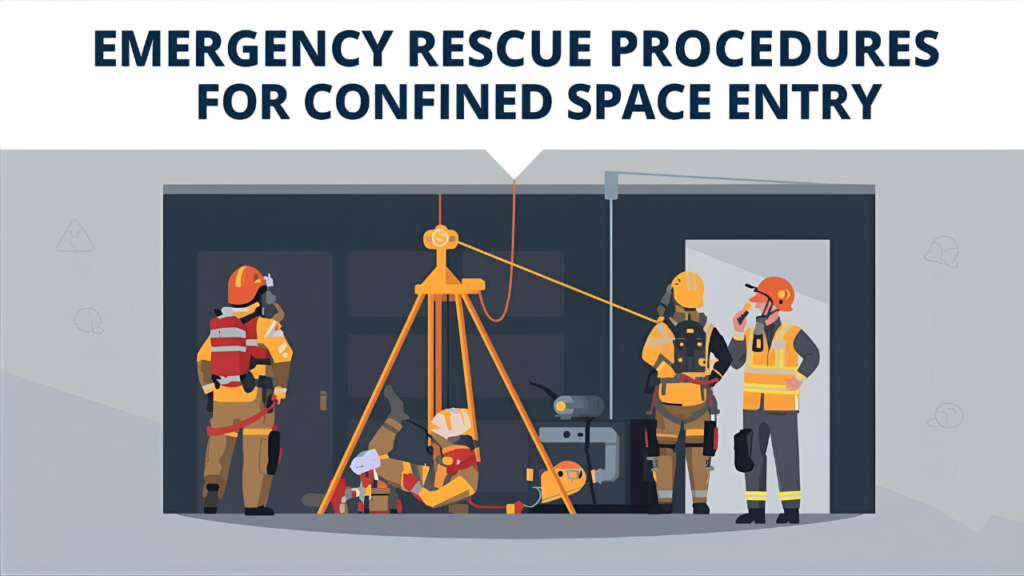
Emergency Rescue Procedures for Confined Space Entry
Confined space emergencies are among the most dangerous workplace incidents. Toxic gases, oxygen deficiency, engulfment, and unexpected atmospheric changes can knock workers unconscious within seconds. What makes confined spaces fatal is not only the initial hazard — but the attempted rescue, where untrained coworkers enter the space and also become victims.
Statistics show that over 60% of confined space deaths are rescuers, not entrants.
This makes proper rescue procedures essential. A rescue operation must be planned, trained, equipped, and executed only by authorized personnel.
This guide explains the full confined space rescue process, including preparation, responsibilities, rescue types, equipment, communication, and emergency decision-making.
What Is a Confined Space Rescue?
A confined space rescue is a planned procedure to safely remove an injured, unconscious, trapped, or endangered entrant from a confined space such as:
- Manholes
- Sewers
- Tanks & vessels
- Silos
- Boilers
- Pipelines
- Tunnels
A rescue plan is mandatory before any entry.
Why Confined Space Rescue Is High Risk
Key reasons:
- Toxic gases accumulate silently
- Oxygen can drop below breathable levels
- Entrant may collapse suddenly
- Rescuers can also suffocate
- Space may be too narrow for movement
- Darkness and poor visibility
- Heat, noise, and water buildup
- Potential for fire or explosion
Rescue must be systematic and not reactionary.
Types of Confined Space Rescue
There are three recognized types:
1. Self-Rescue (Best and Safest Option)
This means the entrant:
- Recognizes danger
- Evacuates on their own
- Responds to alarm or instruction
- Follows the exit route immediately
Self-rescue prevents fatalities and eliminates rescuer exposure.
2. Non-Entry Rescue (Preferred Method)
Rescue WITHOUT sending a rescuer inside.
Examples of non-entry rescue equipment:
- Tripod and winch system
- Lifeline attached to entrant’s harness
- Retrieval device
- Remote hook or grab tool
This is mandatory where possible.
3. Entry Rescue (Last Option)
This occurs when:
- Entrant cannot self-rescue
- Non-entry rescue is not possible
- Entrant is unconscious or trapped
Entry rescue teams must be:
- Fully trained
- Equipped with SCBA or supplied air
- Competent in rope rescue
- Medically fit
- Authorized
Entry rescue is dangerous and must be undertaken only by certified rescuers.
Roles During Confined Space Rescue
Attendant (Standby Person)
Attendant responsibilities:
- Detect emergency
- Order immediate evacuation
- Call rescue team
- NEVER enter the space
- Keep communication active
- Track number of entrants
- Maintain scene safety
The attendant is the first responder — but never enters.
Entry Supervisor
Responsible to:
- Trigger emergency response
- Verify rescue plan activation
- Communicate with site management
- Maintain permit validity
Rescue Team (Authorized Rescuers)
Job includes:
- Assess atmosphere
- Wear SCBA
- Perform entry rescue if needed
- Use retrieval equipment
- Provide first aid
- Transport injured individuals
Rescue teams are trained in:
- Rope rescue
- Vertical lifting
- Hazardous atmosphere response
- CPR and first aid
- Lockout/Tagout (LOTO)
Emergency Rescue Procedure — Step-by-Step
Step 1: Identify the Emergency
Attendant recognizes:
- Loss of communication
- Alarm activation
- Entrant collapse
- Toxic exposure symptoms
- Strange noise or silence
Attendant must act immediately.
Step 2: Order Evacuation
Attendant must:
- Verbally order exit
- Use radio if needed
- Signal through lifeline
If entrant responds → self-rescue happens.
Step 3: Contact the Rescue Team
Attendant must:
- Alert rescue personnel
- Notify supervisor
- Notify emergency medical response
- Provide exact incident details
Step 4: Attempt Non-Entry Rescue
If lifeline or retrieval system is connected:
- Use winch or retrieval device
- Pull entrant out safely
- Do not jerk or drag violently
Non-entry rescue must be attempted FIRST before rescue entry.
Step 5: Rescue Team Performs Atmospheric Testing
Before entering, rescuers check:
- Oxygen levels
- Flammable gases
- Toxic gases
- Ventilation status
Use:
- Multi-gas detector
- SCBA
- Supplied-air respirators
Entry is forbidden until safe entry procedures are confirmed.
Step 6: Lockout/Tagout
Rescuers ensure equipment isolation:
- Electrical
- Mechanical
- Pneumatic
- Hydraulic
- Chemical pipelines
This step prevents re-energization hazards.
Step 7: Ventilation and Purging
Introduce:
- Fresh air ventilation
- Mechanical blower system
- Extraction fans
Hazards must be reduced before entry.
Step 8: Entry Rescue Procedure
Rescue team must:
- Wear SCBA
- Wear harness
- Attach retrieval lines
- Move with controlled entry
- Maintain constant communication
Rescue should be quick but safe.
Step 9: Safe Extraction of Entrant
Rescuers:
- Stabilize the entrant
- Use tripod, winch, or rope system
- Lift vertically if required
- Avoid further injury
Step 10: First Aid & Medical Response
Provide:
- CPR (if needed)
- Oxygen support
- Bleeding control
- Immobilization
Transport to medical facility immediately.
Required Rescue Equipment for Confined Spaces
Essential equipment:
- Tripod or davit system
- Full body harness
- Lifelines
- Winch retrieval device
- SCBA / Airline respirators
- Gas detectors
- Radios
- Fire extinguishers
- First aid kit
- Stretchers
- Ventilation blowers
- Lighting equipment
Rescue equipment must be inspected before and after every use.
Communication During Rescue
Use:
- Radios
- Hand signals
- Tether-line signals
- Voice communication
Communication must be:
- Clear
- Continuous
- Confirmed
Common Mistakes During Confined Space Rescue
Mistake 1: Attendant enters the confined space
This leads to multiple fatalities.
Mistake 2: No rescue equipment installed
Many workers enter without harness and tripod.
Mistake 3: No atmospheric testing
Rescuers become victims of toxic gases.
Mistake 4: Using natural ventilation only
Unpredictable and unsafe.
Real Life Case Study
A worker collapsed in a sewer due to hydrogen sulfide.
Two coworkers attempted rescue without PPE and were immediately overcome.
All three died.
Reason:
No gas testing.
No ventilation.
No rescue equipment.
Attendant entered — fatal mistake.
Key Rules for Confined Space Rescue
- Never perform rescue without SCBA
- Never enter without a rescue plan
- Always attempt non-entry rescue first
- Attendant must never enter
- Continuous atmospheric testing is mandatory
- Rescue must be practiced through drills
Conclusion
Confined space rescue is a high-risk, highly technical operation. The only safe rescue is a planned rescue, with trained personnel, proper equipment, and strict procedures. Never attempt spontaneous rescue — it only creates more victims.
With proper planning, training, equipment, and discipline, confined space rescue can save lives safely and efficiently.
For checklist and templates visit The HSE Tools.
Duties of Confined Space Attendants and Entrants
Ventilation Requirements for Confined Spaces
Confined Space Atmospheric Testing – Gas Detection Explained
Confined Space Entry Permit System Explained
Hazards Associated with Confined Spaces
FAQs
1. Who performs confined space rescue?
Only trained and authorized rescue personnel.
2. Can an attendant enter the confined space to rescue?
No — attendants must never enter.
3. What is the safest rescue method?
Non-entry rescue using a retrieval system.
4. Why is SCBA required for rescue teams?
Because the atmosphere may contain deadly gases.
5. How often should rescue drills be conducted?
At least annually — more frequently for high-risk sites.
