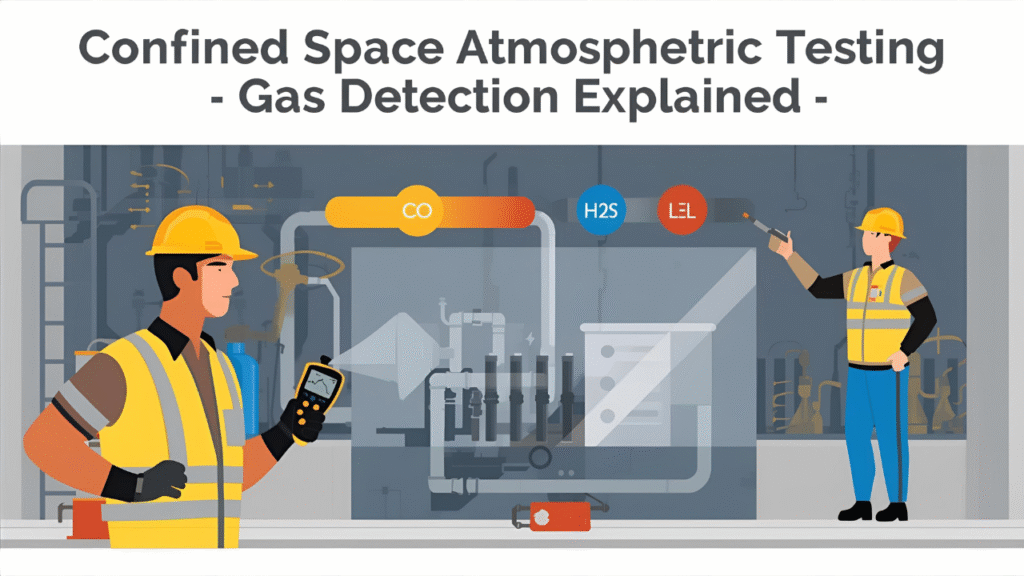
Confined Space Atmospheric Testing – Gas Detection Explained
The most dangerous hazards inside confined spaces are silent, invisible, and instantly deadly. Workers entering sewers, tanks, manholes, ducts, or silos can be exposed to toxic gases or low oxygen levels without warning. The only way to protect workers from these invisible threats is through atmospheric testing and gas monitoring.
This article explains what to test, how to test, when to test, and what equipment to use — a critical guide for every HSE professional and confined space entrant.
Why Atmospheric Testing Is Critical
Primary reasons for testing
- Many toxic gases have no smell
- Some gases displace oxygen
- Workers cannot detect oxygen deficiency
- Gas levels change quickly
- Conditions inside confined spaces fluctuate
- One breath of a toxic gas can be fatal
Example: Hydrogen sulfide (H₂S) at high concentration paralyzes the olfactory nerve — victims don’t even smell it.
What Gases Must Be Tested?
The standard confined space gas testing sequence is:
1. Oxygen Level
Acceptable range: 19.5% – 23.5%
2. Flammable Gases and Vapors
Measured as % of Lower Explosive Limit (LEL)
Safe level: Below 10% of LEL
3. Toxic Gases
Common confined space toxins:
- Hydrogen sulfide (H₂S)
- Carbon monoxide (CO)
- Methane
- Ammonia
- Nitrogen dioxide
- Sulfur dioxide
Some gases are deadly in extremely small concentrations.
Gas Measurement Sequence — The Correct Order
Testing must follow this order:
1 — Oxygen Content
If oxygen is too low — no worker enters.
2 — Flammable Gases
Safe level must be verified.
3 — Toxic Gases
Presence of hazardous gases must be measured.
This order is required because gas levels affect reading sensitivity.
Understanding Each Gas Hazard
Oxygen Deficiency
O₂ <19.5% causes:
- Dizziness
- Confusion
- Loss of consciousness
- Death in minutes
O₂ <10% — immediate fatality
Flammable Gas & Explosion Risk
Methane, propane, and vaporized fuel sources can ignite.
At:
- 10% of LEL — unsafe
- 100% of LEL — explosion ready
Toxic Gas Exposure
Hydrogen sulfide (H₂S)
- Rotten egg smell ONLY at low concentrations
- High levels paralyze smell detection
- Can kill instantly
Carbon monoxide (CO)
- Colorless, odorless
- Prevents oxygen transport in blood
Even small levels are dangerous.
Testing Locations Inside Confined Space
Gas concentrations vary with height.
Gas stratification
- Methane (lighter than air) accumulates at top
- CO spreads evenly
- H₂S (heavier than air) accumulates at bottom
- Low oxygen zones may form anywhere
Therefore test at:
- Top
- Middle
- Bottom
Never assume uniform air composition.
Equipment Used for Atmospheric Testing
Direct-Reading Portable Gas Detectors
Measures:
- O₂
- CO
- H₂S
- LEL
Multi-gas Detectors
Detect multiple gases simultaneously.
Fixed-line continuous monitors
Used in long-term confined space work.
Sampling Tubes & Probes
Used to test before entry.
Calibration and Bump Testing
Testing equipment must be:
- Calibrated regularly
- Bump-tested before each use
- Verified for sensor accuracy
Bump testing confirms that the gas detector actually responds to gases.
When Must Atmospheric Testing Be Performed?
Before entry
No person enters before testing.
Continuously during entry
Conditions can change suddenly.
After breaks or pauses
Gas may accumulate over time.
After cleaning or chemical application
Solvents can release dangerous vapors.
After ventilation system shutdown
Stale air returns quickly.
Continuous Monitoring Requirements
Workers must NOT:
- Test once
- Declare safe
- Enter with confidence
Instead:
- Gas detector must be worn inside
- Alarms must remain active
- Readings must be continuously monitored
Acceptable gas level limits
| Gas | Safe Limit |
|---|---|
| Oxygen (O₂) | 19.5–23.5% |
| Flammable gases | <10% LEL |
| Hydrogen sulfide (H₂S) | <10 ppm |
| Carbon monoxide (CO) | <25–35 ppm |
| Ammonia | <25 ppm |
| Nitrogen dioxide | <3 ppm |
These vary by regulations, but above levels require evacuation.
What If Unsafe Levels Are Detected?
Immediate procedure
- Stop entry
- Evacuate
- Ventilate with fresh air
- Identify gas source
- Retest
Workers must NEVER “hold breath and enter anyway.”
Ventilation Techniques
Forced Air Ventilation
Using mechanical fans or blowers.
Natural Ventilation
Not reliable for confined spaces.
Air extraction ventilation
Removes contaminated air.
Personal Gas Detectors MUST Be Worn
Even if testing shows safe conditions at start.
Detectors worn:
- On chest or breathing zone
- With alarm in audible range
- With visual alarm visibility
Human Limits Related to Gas Exposure
Workers:
- Cannot smell CO
- Lose smell sensitivity to H₂S
- Cannot feel oxygen deficiency
- May collapse without warning
Therefore — trust equipment, not senses.
Entry Supervisor Responsibilities
Must ensure:
- Gas tests recorded
- Detectors calibrated
- Workers trained
- Rescue ready
- Permit is valid
- Alarms audible
Attendant Responsibilities
Must:
- Monitor gas readings
- Maintain contact
- Order evacuation
- Call rescue
Common Mistakes During Gas Testing
- Testing only at surface
- Using expired sensors
- Testing after ventilation only
- Ignoring low oxygen
- Overconfidence
- Removing PPE prematurely
Real-Life Fatal Examples
Case — 3 workers died in sewer
Worker collapsed due to oxygen deficiency.
Two coworkers entered to assist — both immediately collapsed.
All died.
Cause: No testing, no ventilation.
Conclusion
Confined space atmospheric testing is not paperwork, not formality, not “just a quick precaution.” It is the life-or-death barrier between workers and unseen killers.
Trust the gas detector.
Do not trust your senses.
If gas alarms — evacuate immediately.
For checklist and templates visit The HSE Tools.
What Is a Confined Space? Definition and Examples
Confined Space Safety Interview: 50 Questions and Sample Answers
Confined Space JSA (Job Safety Analysis) | Free Download
Confined Space Rescue: Planning and Emergency Procedures
FAQs
1. What is tested first inside a confined space?
Oxygen level.
2. Do gas levels need continuous monitoring?
Yes — throughout occupation.
3. Can workers smell dangerous gases?
Many cannot — gas must be detected instrumentally.
4. What is safe oxygen concentration?
19.5 to 23.5 percent.
5. Should gas detectors be worn inside?
Yes — always.
