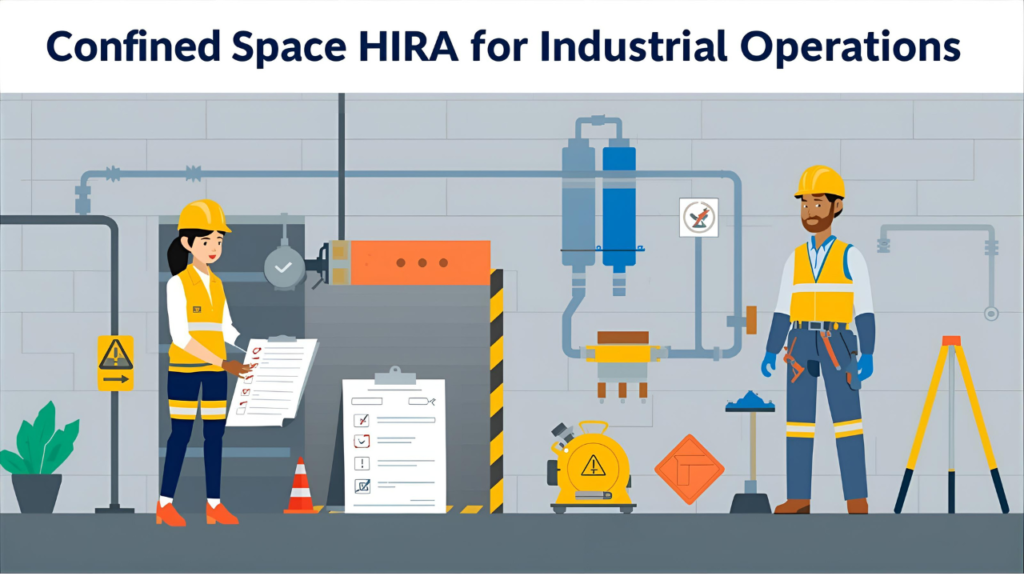
Confined Space HIRA for Industrial Operations
Confined spaces are among the most hazardous work environments in industrial operations. Poor ventilation, toxic gases, engulfment risks, extreme temperatures, and limited access make confined space incidents fatal within seconds. To control these risks, organizations must perform a Confined Space HIRA (Hazard Identification & Risk Assessment) before any worker enters.
A well-structured HIRA identifies hazards, evaluates their severity and likelihood, assigns risk ratings, and establishes strong control measures to protect entrants, attendants, and rescue teams. This guide explains a complete confined space HIRA tailored for industrial operations.
What Is Confined Space HIRA?
Confined Space HIRA is a systematic process that focuses on:
- Recognizing hazards
- Assessing risks
- Implementing control measures
- Documenting safe entry requirements
- Ensuring compliance with legal and safety standards
It is mandatory under confined space regulations worldwide.
Why HIRA Is Critical for Confined Space Work
Industrial confined spaces can quickly become life-threatening due to:
- Toxic gas accumulation
- Oxygen deficiency
- Flammable vapors
- Heat stress
- Limited escape routes
- Mechanical or chemical hazards
HIRA helps prevent fatal accidents by ensuring hazards are known, understood, controlled, and monitored.
Hazard Categories in Confined Space Industrial Operations
Confined space hazards fall into major categories:
Atmospheric Hazards
Oxygen Deficiency
Occurs due to:
- Rusting
- Chemical reactions
- Gas displacement
Less than 19.5% oxygen can cause rapid unconsciousness.
Toxic Gases
Common industrial toxins:
- Hydrogen sulfide (H₂S)
- Carbon monoxide (CO)
- Ammonia
- Methane
- Nitrogen dioxide
These gases can be lethal without warning.
Flammable or Explosive Atmosphere
When vapors reach 10% LEL, the environment becomes explosive.
Engulfment Hazards
Entrants can be engulfed by:
- Sludge
- Sand
- Grain
- Chemicals
- Water
Engulfment is one of the most fatal confined space hazards.
Physical Hazards
Include:
- Falling objects
- Hot or sharp surfaces
- Noise
- Poor visibility
- Slippery floors
- Structural instability
Mechanical & Energy Hazards
Hazards include:
- Rotating machinery
- Agitators
- Mixers
- Pumps
- Conveyors
LOTO (Lockout/Tagout) is mandatory before entry.
Thermal Hazards
High heat can cause:
- Heat stress
- Dehydration
- Fatigue
- Collapse
Low temperatures increase risk of cold stress.
Biological Hazards
Common in sewers, tanks, and wastewater pits:
- Bacteria
- Fungi
- Contaminated water
- Sewage gases
Psychological & Ergonomic Hazards
Entrants may face:
- Claustrophobia
- Stress
- Panic
- Fatigue
- Restricted movement
These increase the likelihood of mistakes.
Confined Space HIRA Table for Industrial Operations
Below is a structured HIRA table you can use for industrial confined space work.
Confined Space HIRA Table
| Hazard | Risk Description | Possible Consequences | Risk Level (Before Control) | Control Measures | Residual Risk |
|---|---|---|---|---|---|
| Oxygen deficiency | O₂ <19.5% | Unconsciousness, death | High | Pre-entry testing, ventilation, continuous gas monitoring, SCBA | Low |
| Toxic gases (H₂S, CO) | Inhalation of gases | Respiratory failure, death | High | Ventilation, gas detectors, alarms, SCBA | Low |
| Flammable gases | Vapors near ignition source | Explosion, burns | High | Intrinsically safe tools, EX-rated equipment, gas monitoring | Low |
| Engulfment | Sludge, water, grain collapse | Suffocation, entrapment | High | Barriers, dewatering, entry harness, rescue plan | Medium |
| Mechanical hazards | Moving parts, agitators | Amputation, crush injury | High | LOTO, isolation, mechanical guards | Low |
| Electrical hazards | Exposed wiring, equipment | Shock, burns | Medium | Lockout, insulated tools, GFCI | Low |
| Heat stress | High temperature | Collapse, dehydration | Medium | Ventilation, cooling breaks, hydration | Low |
| Slip/Trip hazards | Wet/slippery floors | Injury, sprains | Medium | Housekeeping, anti-slip mats, lighting | Low |
| Poor communication | Noise or obstructions | Delayed response, panic | Medium | Radios, attendants, hand signals | Low |
| Restricted access | Only one entry/exit | Rescue difficulty | High | Tripod/winch system, rescue team standby | Medium |
| Chemical exposure | Liquid or vapor release | Burns, poisoning | High | PPE, chemical-resistant gloves & suits | Low |
| Biological contaminants | Sewage, microbes | Infection, illness | Medium | PPE, hygiene protocols | Low |
This table can be expanded depending on the operation.
Hierarchy of Controls for Confined Space Hazards
HIRA must follow recognized control hierarchy:
Elimination
Remove the need to enter — use remote tools if possible.
Substitution
Use less hazardous chemicals.
Engineering Controls
- Ventilation
- Isolation
- Barriers
- Gas monitoring systems
Administrative Controls
- Permit-to-work
- Training
- SOPs
- Supervision
PPE
Last line of defense — harness, respirators, gloves, etc.
Step-by-Step Confined Space HIRA Process
Step 1: Identify the Confined Space
Analyze:
- Purpose
- Size
- Access points
- Potential hazards
- Isolation requirements
Step 2: Identify Hazards Present
A hazard checklist should include:
- Atmospheric hazards
- Energy sources
- Engulfment risks
- Chemical exposure
- Biological agents
- Electrical hazards
- Noise
- Temperature
Step 3: Evaluate Risk Severity and Likelihood
Assess:
- Potential impact
- Exposure duration
- Frequency of work
- Environmental conditions
Assign risk rating (High/Medium/Low).
Step 4: Establish Control Measures
Controls include:
- Ventilation
- Gas testing
- PPE
- LOTO
- Attendant monitoring
- Rescue equipment ready
Step 5: Implement Safe Work Procedures
This includes:
- Permit-to-work system
- Pre-entry checklist
- Toolbox talk
- Authorized personnel only
Step 6: Monitor the Work Continuously
Monitor:
- Gas levels
- Worker condition
- Communication
- Ventilation performance
- Environmental changes
Step 7: Document the HIRA
Documentation ensures:
- Traceability
- Accountability
- Compliance
Step 8: Review and Update HIRA
HIRA must be updated when:
- New hazards identified
- Change in work conditions
- New materials introduced
- Near miss or incident occurs
Control Measures for Common HIRA Findings
Atmospheric Controls
Mechanical Ventilation
Use blowers or ducts.
Pre-entry and continuous testing
Using calibrated multi-gas detectors.
Respiratory protection
APR, SAR, SCBA depending on hazard.
Physical Hazard Controls
Lighting
Intrinsically safe lights.
Fall prevention
Harness and tripod system.
Noise reduction
Hearing protection where needed.
Engulfment Controls
Barriers and dewatering
Remove liquid or solids before entry.
Harness with retrieval line
Prevents full engulfment.
Administrative Controls
Training
Entrants, attendants, and supervisors.
Permit-to-work
Mandatory.
Role clarity
Entrants, attendants, rescue team.
PPE Controls
Mandatory PPE includes:
- Helmet
- Safety boots
- Gloves
- Protective suit
- Goggles
- Harness
- Lifeline
- Gas detector
Confined Space HIRA Example for Common Industrial Spaces
Manholes
Major hazards:
- H₂S
- Methane
- Oxygen deficiency
- Drowning
- Slips
Tanks
Hazards:
- Chemical vapors
- Residue
- Heat
- Engulfment
Boilers
Hazards:
- Heat stress
- Limited mobility
- Pressure hazards
Each confined space requires its own HIRA.
Conclusion
A Confined Space HIRA for industrial operations is not just a document — it is the foundation of safe confined space work. Identifying hazards, analyzing risks, and implementing effective control measures protect workers from invisible and deadly dangers. With proper planning, monitoring, and rescue readiness, confined space entries can be carried out safely and efficiently.
Confined space hazards are unforgiving — but a strong HIRA saves lives.
For checklist and templates visit The HSE Tools.
Emergency Rescue Procedures for Confined Space Entry
Duties of Confined Space Attendants and Entrants
Ventilation Requirements for Confined Spaces
Confined Space Atmospheric Testing – Gas Detection Explained
Confined Space Entry Permit System Explained
FAQs
1. Is HIRA mandatory for confined space entry?
Yes, it is legally required in most safety regulations.
2. How often should HIRA be updated?
Whenever conditions change or after any incident or near miss.
3. Who performs the confined space HIRA?
Safety officers, supervisors, and competent persons together.
4. Are gas detectors part of the HIRA process?
Yes, atmospheric monitoring is a key hazard control.
5. Is the rescue plan part of the HIRA?
Yes — rescue requirements must be documented within HIRA.
