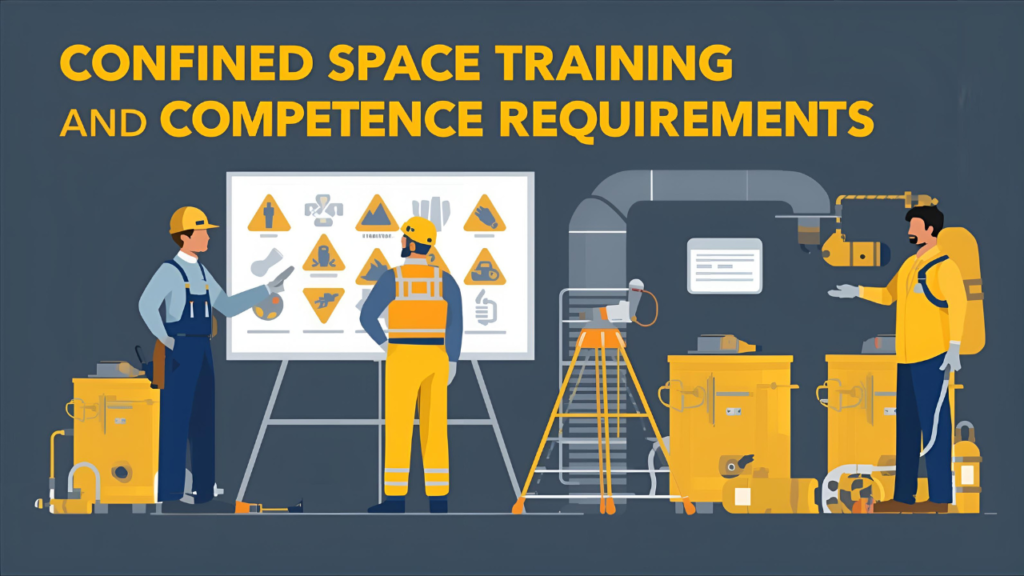
Confined Space Training and Competency Requirements
Confined spaces are some of the most dangerous work environments in industrial settings. Workers entering manholes, tanks, silos, tunnels, boilers, and sewers face multiple hazards that can become fatal in seconds — oxygen deficiency, toxic gases, flammable vapors, entrapment, and limited mobility.
Because these hazards are unique and extremely high-risk, proper confined space training and competency verification are mandatory before any worker is allowed to enter, supervise, or assist with confined space work.
This article explains the skills, training modules, refresher requirements, competency evaluation methods, and legal expectations for all confined space roles: Entrants, Attendants, Supervisors, and Rescue Personnel.
Why Confined Space Training Is Mandatory
Confined space work is different from normal industrial work because:
- Hazards are invisible
- Air becomes dangerous without warning
- Movement is restricted
- Communication is difficult
- Rescue is complex
- Panic can lead to fatal mistakes
Untrained workers may:
- Fail to recognize gas hazards
- Ignore alarms
- Enter without PPE
- Attempt unsafe rescues
- Panic during emergencies
Training ensures workers know what to do, when to do it, and how to do it safely — without putting others at risk.
Regulatory Requirements for Confined Space Training
Most safety standards require confined space training, including:
- OSHA 29 CFR 1910.146 (USA)
- ISO 45001 (International)
- HSE Confined Space Regulations 1997 (UK)
- State Factories Rules (India)
- NFPA Guidelines
- National Fire Codes
All require:
- Training before initial assignment
- Competency testing
- Frequent refreshers
- Role-specific qualifications
- Documented proof of training
Who Needs Confined Space Training?
Three key job roles require specialized training:
Authorized Entrants
Workers entering the confined space.
Attendants (Standby Personnel)
Workers stationed outside monitoring the entrant.
Entry Supervisors
Individuals approving permits and ensuring compliance.
Rescue Personnel
Trained team who perform rescue operations.
Each role has different training requirements.
Training Requirements for Authorized Entrants
Entrants must fully understand:
- Hazards of confined spaces
- Atmospheric testing procedures
- Oxygen, H₂S, CO, and LEL limits
- Use of gas detectors
- Ventilation requirements
- PPE usage
- SCBA use (if required)
- Harness and lifeline connection
- Safe entry and exit techniques
- Communication methods
- Emergency response
- Alarm signals and evacuation procedures
Entrant Skill Competencies
Entrants must demonstrate:
- Ability to recognize dangerous atmospheres
- Correct donning of PPE
- Operation of multi-gas detectors
- Understanding of ventilation airflow
- Safe work practices inside confined space
- Calm behavior and hazard reporting
Entrant training is valid only after competency is verified by testing or practical demonstration.
Training Requirements for Attendants (Standby Personnel)
Attendants are responsible for monitoring entrants. Their training must include:
- Hazard recognition
- Continuous communication techniques
- Maintaining entrant headcount
- Use of radios, alarms, or signals
- Monitoring gas detection readings
- Initiating evacuation
- Prohibiting unauthorized entry
- Not entering the confined space
- Emergency reporting
- Basic first aid awareness
- Rescue activation procedures
Attendant Competency Requirements
Attendants must:
- Stay alert and focused
- Never leave their post
- Never attempt unauthorized rescue
- Maintain communication and control
Attendant training must include real-life simulations.
Training Requirements for Entry Supervisors
Supervisors authorize entry and ensure all safety procedures are followed.
Key training areas:
- Confined space regulations
- HIRA (Hazard Identification & Risk Assessment)
- Permit-to-Work System
- Isolation and LOTO requirements
- Verification of gas testing
- Equipment inspection
- PPE verification
- Rescue plan validation
- Communication protocols
- Documentation and recordkeeping
Supervisor Competencies
Supervisors must be able to:
- Evaluate all hazards
- Authorize or cancel permits
- Confirm rescue readiness
- Identify unsafe behavior
- Enforce evacuation
Supervisors require the highest competency level.
Training Requirements for Rescue Personnel
Rescue teams must undergo the most advanced training.
Essential training includes:
- Confined space rescue techniques
- Rope rescue
- Vertical and horizontal extraction
- Tripod and winch operation
- SCBA training
- Atmospheric hazard assessment
- First aid and CPR
- Trauma management
- Emergency coordination
- Incident command system
- Use of rescue stretchers
Rescue Competency Requirements
Rescue teams must be:
- Physically fit
- Fully trained in SCBA
- Capable of confined space entry
- Certified in technical rescue
- Regularly drilled
NFPA recommends rescue teams perform quarterly rescue drills.
Core Topics Covered in Confined Space Training
Training programs must include the following:
Hazard Awareness Training
Workers learn:
- Atmospheric hazards
- Mechanical hazards
- Engulfment risks
- Electrical hazards
- Thermal hazards
- Communication hazards
- Ergonomic and psychological hazards
Understanding hazards is the foundation of competency.
Atmospheric Testing and Gas Monitoring Training
Workers must learn:
- Gas testing sequence (O₂ → LEL → toxics)
- Use of multi-gas detectors
- Sensor calibration
- Alarm thresholds
- Continuous monitoring requirements
- Gas density and stratification
Without atmospheric testing training, entry is unsafe.
Ventilation Training
Workers are trained in:
- Mechanical ventilation use
- Airflow direction
- Ducting setup
- Avoiding dead-air pockets
- Continuous ventilation rules
Ventilation keeps air breathable.
PPE Training
Training must cover:
- Helmet use
- Safety goggles
- Gloves
- Protective suits
- Steel-toe boots
- Respiratory protection
- SCBA donning/doffing
- Harness and lifeline usage
Workers must demonstrate proper PPE usage.
Permit-to-Work Training
Personnel are trained to:
- Read and understand permits
- Identify limitations
- Verify signatures
- Follow time limits
- Respect cancellation conditions
Permit-to-work prevents unauthorized and unsafe entry.
Communication Training
Workers learn:
- Radio communication
- Hand signals
- Lifeline signals
- Voice commands
- Emergency communication protocol
Communication must be clear and continuous.
Emergency Response and Rescue Training
Workers must learn:
- Evacuation signals
- Alarm response
- Calling for rescue
- Self-rescue
- First aid basics
- Not performing untrained rescue
Emergency response training prevents panic and chaos.
Competency Assessment Process
Training alone is NOT enough. Competency must be verified.
Assessment Methods:
- Written tests
- Practical demonstrations
- Role simulation exercises
- Supervisor evaluation
- PPE usage evaluation
- Gas detector operation test
- Rescue drill participation
Workers failing any assessment must undergo retraining.
Refresher Training Requirements
Refresher training is required:
- Every year (recommended)
- After incidents
- After near-misses
- When new hazards introduced
- When equipment changes
- When job roles change
Documentation of refresher training must be maintained.
Training Documentation Requirements
Employers must maintain:
- Training records
- Competency certificates
- Attendance sheets
- Evaluation results
- Reassessment history
- Rescue drill records
These documents must be available for audit.
Consequences of Inadequate Training
Lack of training leads to:
- Confusion during emergencies
- Incorrect use of gas detectors
- Improper PPE handling
- Unauthorized rescue attempts
- Fatal collapses
- Multiple casualties
Training saves lives — ignorance kills.
Conclusion
Confined space training and competency verification are essential for safe operations. Every entrant, attendant, supervisor, and rescue team member must be fully trained, assessed, and certified before participating in confined space work. Proper training ensures hazards are recognized early, procedures are followed correctly, and emergencies are handled safely.
Confined spaces do not forgive mistakes. Competency is the only way to prevent tragedies.
For checklist and templates visit The HSE Tools.
Confined Space PPE and Equipment Checklist
Emergency Rescue Procedures for Confined Space Entry
Duties of Confined Space Attendants and Entrants
Ventilation Requirements for Confined Spaces
Confined Space Atmospheric Testing – Gas Detection Explained
FAQs
1. How often should confined space training be repeated?
Annually or after any major change in work conditions.
2. Who needs confined space training?
Entrants, attendants, supervisors, and rescue personnel.
3. Is hands-on training mandatory?
Yes — practical competency must be verified.
4. Do rescue teams need SCBA certification?
Yes — rescue requires SCBA training and drills.
5. What documents prove training competency?
Certificates, evaluation results, and training records.
