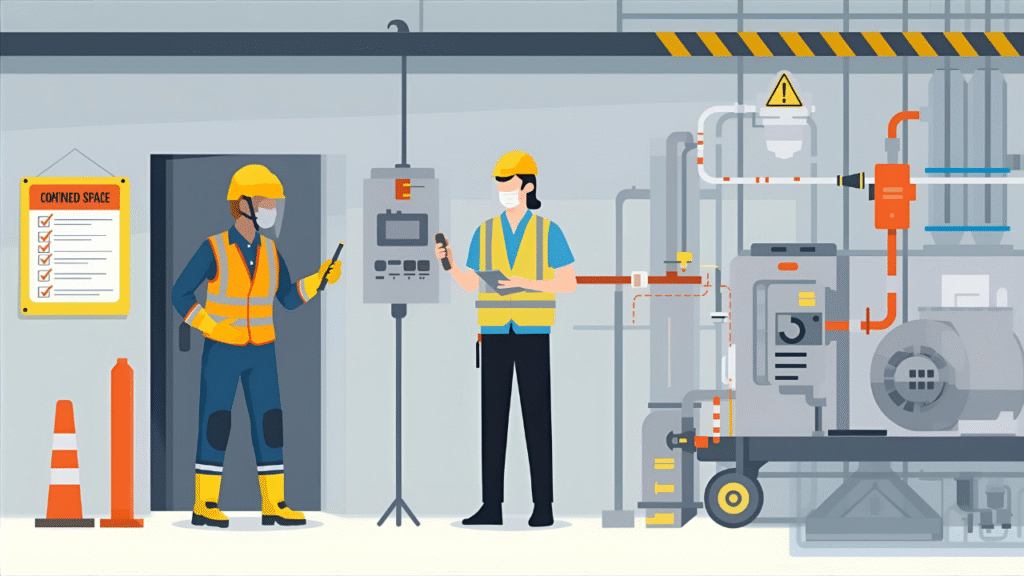
Duties of Confined Space Attendants and Entrants
In confined space work, safety depends on teamwork, discipline, and strict role-based accountability. Two key roles are essential for preventing accidents and ensuring proper communication during entry: the Entrant and the Attendant (or Standby Person). Each of these positions has specific safety responsibilities that must be clearly understood and followed.
This article explains these roles in detail and defines what each person MUST and MUST NOT do.
Who Is an Entrant?
Definition
An entrant is a trained worker who physically enters the confined space to perform assigned tasks under a valid Entry Permit.
Typical examples of entrants
- Inspectors
- Maintenance personnel
- Cleaners
- Welders
- Utility workers
- Technicians
Entrants are the individuals directly exposed to confined space hazards.
Responsibilities of Entrants
Before entering the confined space
Entrants must:
- Review the hazards
- Understand permit conditions
- Wear appropriate PPE
- Verify gas detector function
- Test atmosphere if required
- Attend toolbox talk
- Understand emergency signals
While inside the confined space
Entrants must:
- Continuously monitor atmospheric conditions
- Maintain verbal or radio communication with attendant
- Stop work if conditions change
- Exit immediately when instructed
- Follow all established procedures
- Never remove safety equipment
- Avoid unsafe improvisations
Entrant evacuation requirement
Entrants must exit the confined space:
- When alarm sounds
- When gas detector alerts
- When attendant orders evacuation
- When symptoms of dizziness, nausea, confusion appear
- When atmospheric conditions change
- When PPE fails
An entrant must NEVER ignore evacuation signals.
Entrant PPE Responsibilities
Entrants must use:
- Helmet
- Safety boots
- Gloves
- Harness & lifeline
- Gas detector
- Respiratory protection (as needed)
Entrants are responsible for wearing and maintaining PPE.
Behavioral Expectations of Entrants
Entrants must:
- Stay alert
- Avoid panic
- Communicate clearly
- Follow instructions
- Never work alone
Who Is an Attendant (Standby Person)?
Definition
A confined space attendant is a designated person stationed outside the entry point who continuously monitors the entrants.
The attendant NEVER enters the confined space.
Their duty is observation and emergency control from outside.
Responsibilities of the Attendant
Before entry
Attendant must:
- Understand hazards
- Confirm permit validity
- Verify atmospheric testing results
- Ensure rescue equipment is ready
- Count number of entrants
- Confirm communication system working
During entry
The attendant must:
- Maintain constant communication with entrants
- Monitor gas readings from detectors (if accessible)
- Watch for signs of distress or confusion
- Track authorized entrants
- Prevent unauthorized entry
- Order immediate evacuation if risk arises
- Contact rescue personnel if required
During emergency
Attendant must:
- Not enter the confined space
- Order entrants to evacuate
- Call emergency rescue team
- Use retrieval systems if available
- Protect themselves and prevent secondary victims
Most confined space fatalities occur when attendants recklessly enter without respiratory protection.
Attendant Communication Responsibilities
Communication methods
- Two-way radio
- Voice communication
- Tether-line signals
- Hand signals
- Light signals
Attendant must ensure every message is:
- Clear
- Confirmed
- Understood
Attendant Monitoring Responsibilities
Attendant must watch for:
- Entrant unusual behavior
- Signs of dizziness
- Slow responses
- Loss of communication
- Movement failure
- Unusual noises
- Sudden silence
These may indicate dangerous conditions.
Attendant Authority
Attendant holds decision-making authority to:
- Order entrants to leave
- Stop work
- Cancel job activity
This role carries high responsibility — not a passive position.
Attendant Prohibited Actions
Attendant must NOT:
- Perform other tasks
- Leave the entry point
- Become distracted
- Ignore alarms
- Enter the confined space
Even in emergencies — the attendant must remain outside.
Differences Between Entrants and Attendants
| Aspect | Entrant | Attendant |
|---|---|---|
| Location | Inside confined space | Outside confined space |
| Role | Perform work | Monitor and protect |
| Hazard exposure | High | Lower |
| Rescue role | Evacuate self | Call rescue team |
| Authority | Follows instructions | Can order evacuation |
| Work responsibilities | Task oriented | Safety oriented |
Training Requirements
Entrants and attendants must be trained in:
- Hazard identification
- Oxygen and gas risks
- Use of gas detectors
- Emergency protocols
- PPE usage
- Communication protocol
- Rescue procedure awareness
- Permit conditions
Example Scenarios
Scenario 1 — Entrant detects dizziness
Entrant reports to attendant.
Attendant orders evacuation.
Entrant exits safely.
Scenario 2 — Gas alarm sounds
Entrant immediately stops work.
Attendant orders evacuation.
Emergency personnel notified.
Scenario 3 — Entrant goes silent
Attendant tries communication.
If no response → orders evacuation.
Does NOT enter inside.
Calls rescue team.
Role of Entry Supervisor (Additional Context)
The supervisor:
- Approves permit
- Confirms conditions safe
- Ensures proper training
- Authorizes workers
- Cancels permit
While the supervisor manages system, the attendant enforces live site safety.
Why These Roles Must Not Overlap
Entrants focus on work.
Attendants focus on safety.
If an attendant performs other duties:
- Monitoring suffers
- Communication fails
- Emergencies go unnoticed
If an entrant takes on monitoring:
- Attention divided
- Risk increases
Roles must remain separate and clear.
Conclusion
Confined space work demands strict adherence to defined duties. The entrant is responsible for working safely inside the confined space, while the attendant is responsible for monitoring safety from outside. The attendant is the lifeline — eyes, ears, and voice of safety — ensuring emergencies are managed without additional casualties.
When both roles are properly fulfilled, confined space entry becomes controlled, predictable, and safe.
For checklist and templates visit The HSE Tools.
Ventilation Requirements for Confined Spaces
Confined Space Atmospheric Testing – Gas Detection Explained
Confined Space Entry Permit System Explained
Hazards Associated with Confined Spaces
What Is a Confined Space? Definition and Examples
FAQs
1. Can the attendant leave the entry area momentarily?
No — the attendant must remain posted continuously.
2. Can attendants perform rescue?
Only external rescue operations using retrieval equipment — they must not enter.
3. Can one attendant monitor multiple confined spaces at once?
No — one attendant per space.
4. Can entrants work without harness?
No — unless space is extremely shallow and authorized.
5. Who can cancel the permit?
Only the entry supervisor.
