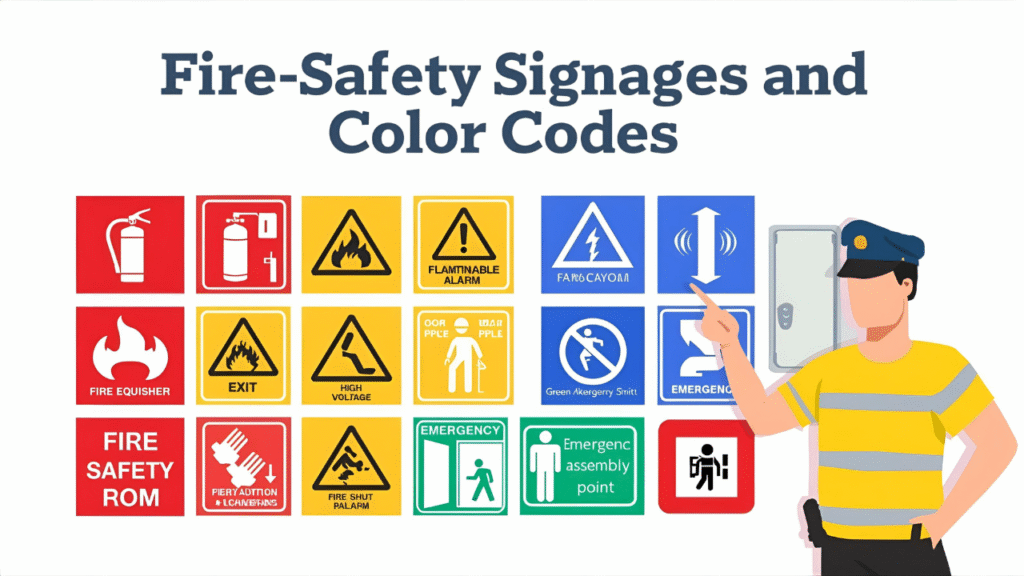
Fire Safety Signages and Color Codes Explained
During a fire emergency, there is no time to think — people must react instantly. Fire safety signages and color codes provide visual guidance that helps workers identify escape routes, firefighting equipment, alarms, hazards, and safe areas.
Proper signage placement and correct interpretation are critical for emergency response and regulatory compliance.
Why Fire Safety Signages Are Important
Fire safety signage:
- Guides employees during emergencies
- Helps in quick identification of fire equipment
- Improves workplace safety awareness
- Supports emergency evacuation
- Helps comply with legal safety regulations
- Reduces injuries and fatalities
A workplace with correct safety signage is safer, more organized, and less chaotic during an incident.
Fire Safety Signage Categories
Fire safety signages are grouped into four major categories:
1. Prohibition Signs (Red)
Used to show what is not allowed.
Examples:
- No Smoking
- No Open Flame
- No Entry
- Do Not Use Elevator During Fire
Color Meaning:
- Red circle with a diagonal slash
- Represents danger or restriction
These prevent unsafe actions that may trigger or worsen a fire.
2. Warning Signs (Yellow / Amber)
Used to indicate potential hazards.
Examples:
- Flammable Materials
- High Voltage
- Explosive Hazard
- Oxygen in Use
Color Meaning:
- Yellow triangle with black border
- Symbol alerts workers to be cautious
These signs help workers identify fire-prone areas.
3. Mandatory Signs (Blue)
Indicate actions that must be followed.
Examples:
- Fire Door Keep Shut
- Wear PPE
- Safety Instructions
- Use Handrails
Color Meaning:
- Blue circle with white symbol
- Represents required action
These signs enforce essential safety behaviors.
4. Emergency Information and Safe Condition Signs (Green)
Provide directions to safe locations and emergency facilities.
Examples:
- Emergency Exit
- Assembly Point
- First Aid
- Escape Route
Color Meaning:
- Green rectangle or square with white text/symbol
- Indicates safety or assistance
These signs guide people to safety during emergency evacuation.
5. Fire Equipment Signs (Red)
Used to identify firefighting installations.
Examples:
- Fire Extinguisher
- Hose Reel
- Fire Hydrant
- Fire Alarm
Color Meaning:
- Solid red background with white symbol/text
- Easy to distinguish from other signs
These help locate fire emergency tools quickly.
Color Code Summary Table
| Color | Meaning | Used For |
|---|---|---|
| Red | Prohibition / Fire Equipment | No smoking, Fire extinguishers |
| Yellow | Warning | Flammable area, High voltage |
| Blue | Mandatory | PPE required, Fire door |
| Green | Safe Condition | Assembly point, Emergency exit |
Standards Governing Fire Safety Signage
Fire signage follows global safety standards such as:
- ISO 3864
- ISO 7010
- OSHA 29 CFR 1910
- NFPA standards
These ensure consistency and universal understanding.
Where Fire Signages Must Be Installed
Fire safety signages should be placed at:
- Exit doors
- Stairways
- Assembly points
- Electrical panels
- Chemical storage rooms
- Fire extinguisher stations
- Emergency control panels
- Heavy machinery areas
Proper signage placement ensures visibility during low-visibility conditions like smoke or panic.
Common Mistakes in Fire Safety Sign Usage
- Signs placed too high or too low
- Using faded or poorly printed signs
- Blocked or obstructed signage
- Wrong color coding
- Too many signs causing confusion
- Signs not illuminated in darkness
- No multilingual or pictogram support
An ineffective sign can be more dangerous than none at all.
Best Practices for Fire Safety Sign Implementation
- Use standardized pictograms
- Keep symbols simple and universal
- Place signs consistently at all locations
- Use reflective or illuminated materials
- Maintain visibility at eye-level
- Inspect signs regularly
- Replace damaged or faded signage
- Provide employee training on symbol meaning
Employee Awareness and Training
Workers must be trained to:
- Recognize safety symbols
- Understand signage meanings
- Follow mandatory signs
- Locate fire equipment
- Know nearest exits and assembly points
A trained workforce responds better in emergencies.
Conclusion
Fire safety signages and color codes are essential components of workplace safety. Clear visual communication leads to faster evacuation, better hazard recognition, and improved safety culture. Proper use of signage is not just compliance — it is an investment in protecting lives and property.
Safety signs speak — even when people can’t.
For checklist and templates visit The HSE Tools.
How to Maintain and Inspect Fire Extinguishers
Fire Detection and Alarm Systems Explained
Common Fire Hazards in Industries and Their Controls
Importance of Fire Drills and Mock Drills
Fire Emergency Evacuation Procedures at Work
Frequently Asked Questions (FAQs)
1. Why is green used for emergency exits?
Because green universally indicates safety and direction.
2. Are fire extinguishers always marked in red?
Yes — globally red is the standard color for fire equipment identification.
3. Should signs include text or only symbols?
Best practice is symbols + text for clarity.
4. How often should signs be inspected?
At least once per year or after any facility changes.
5. Are safety sign shapes standardized?
Yes — circles, triangles, and rectangles have defined meanings in ISO standards.
