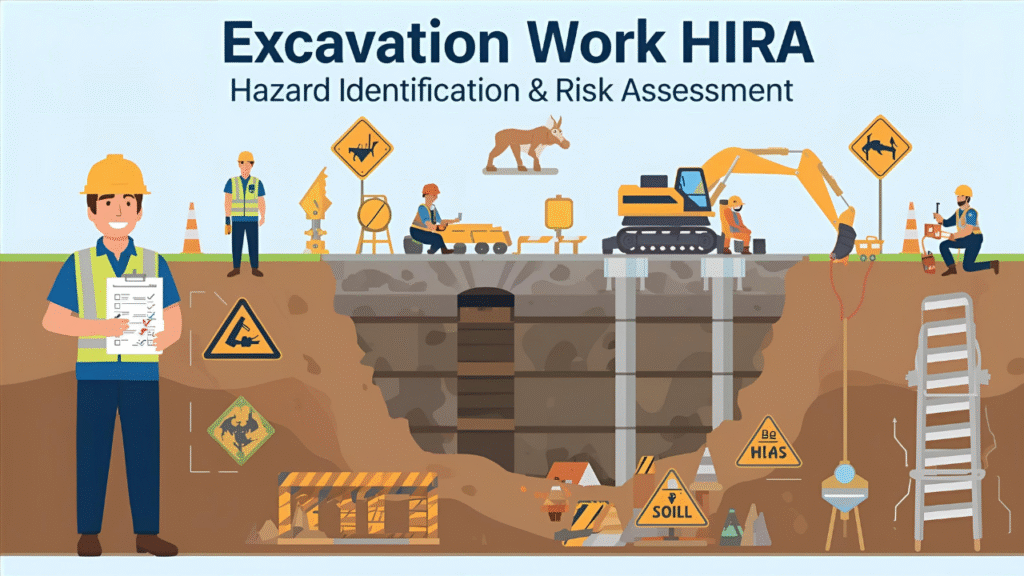
HIRA for Excavation Work (Hazard Identification & Risk Assessment)
Excavation is one of the deadliest construction activities due to unstable soil, underground utilities, heavy machinery, and hazardous atmospheres. A HIRA (Hazard Identification & Risk Assessment) provides a structured method for identifying risks before digging begins and applying effective controls.
This document is a practical, real-world excavation HIRA — written for safety officers, supervisors, engineers, and competent persons responsible for trench and excavation safety.
Objectives of Excavation HIRA
What HIRA aims to achieve
- Identify hazards that can cause injury, damage, or fatality
- Assess the severity and likelihood of each hazard
- Assign risk ratings
- Implement appropriate control measures
- Reduce risk to an acceptable level
- Ensure legal and regulatory compliance
Understanding Excavation Work Hazards
Excavation hazards can be grouped into key categories:
Geotechnical Hazards
- Soil collapse
- Loss of structural stability
- Groundwater seepage
Atmospheric Hazards
- Toxic gases
- Low oxygen
- Vapors and fumes
Mechanical Hazards
- Machinery movement
- Falling loads
- Equipment-human interaction
Service-Related Hazards
- Utility strikes
- Electrocution
- Gas line rupture
Environmental Hazards
- Rain-induced collapse
- Heat stress
- Flooding
Risk Rating Methodology
We use risk matrix approach:
Likelihood (L):
1 — Rare
2 — Unlikely
3 — Possible
4 — Likely
5 — Almost certain
Severity (S):
1 — Minor injury
2 — First-aid
3 — Medical treatment
4 — Major injury / permanent disability
5 — Fatality
Risk Rating = L × S
| Score | Risk Level |
|---|---|
| 1–4 | Low |
| 5–9 | Medium |
| 10–16 | High |
| 17–25 | Extreme |
Excavation Work HIRA Table
Hazard Identification & Control Measures Table
| Hazard | Risk | L | S | Risk Rating | Control Measures |
|---|---|---|---|---|---|
| Cave-ins / trench collapse | Burial, fatal suffocation | 4 | 5 | 20 (Extreme) | Sloping, benching, shoring, trench boxes, soil testing, competent person supervision |
| Contact with underground utilities | Fire, electrocution, explosion | 3 | 5 | 15 (High) | Cable detection, GPR scanning, utility maps, “Permit to Dig”, hand digging near utilities |
| Flooding / water ingress | Entrapment, drowning | 3 | 4 | 12 (High) | Dewatering systems, pumps, drainage, water diversion |
| Falling into trench | Broken bones, head injury | 3 | 3 | 9 (Medium) | Barriers, warning tape, guard rails, signage |
| Falling loads / dropped tools | Head injuries, death | 3 | 5 | 15 (High) | Exclusion zones, lifting procedures, PPE (helmets), tool tethering |
| Machinery striking worker | Crushing injuries | 3 | 4 | 12 (High) | Spotter guidance, operator training, reverse alarms |
| Hazardous gases / low oxygen | Asphyxiation | 3 | 5 | 15 (High) | Gas detection, ventilation, confined-space procedures |
| Heat exposure | Heat stroke, dehydration | 3 | 3 | 9 (Medium) | Shade, hydration, work-rest cycles |
| Slip / trip hazards | Minor injuries | 2 | 2 | 4 (Low) | Clean pathways, proper housekeeping |
| Vibration affecting soil | Collapse risk | 3 | 4 | 12 (High) | Shoring reinforcement, vibration monitoring |
| Spoil piles too close to edge | Wall collapse | 4 | 5 | 20 (Extreme) | Keep spoil pile 2 ft away |
| Working at depth without access | Entrapment | 3 | 4 | 12 (High) | Ladders every 25 ft, escape routes |
| Poor visibility at night | Accidents | 2 | 3 | 6 (Medium) | Adequate lighting |
| Lack of worker training | Unsafe actions | 4 | 4 | 16 (High) | Excavation training, toolbox talks |
Hierarchy of Controls for Excavation Work
1. Elimination
Avoid excavation where possible
Example: Using alternative routing.
2. Substitution
Use non-destructive digging (vacuum excavation)
3. Engineering Controls
- Sloping and benching
- Shoring systems
- Trench boxes
- Barriers
4. Administrative Controls
- Permits
- Training
- Procedures
- Supervision
5. PPE
Last line of defense — helmets, gloves, boots, vests.
Pre-Excavation Safety Checks
Before digging begins
- Permit to Work obtained
- Soil classification completed
- Utility scanning performed
- Emergency plan prepared
- Rescue equipment available
- Competent person appointed
- Weather forecast reviewed
During Excavation Activities
Daily inspections
Must occur:
- At the start of shift
- After rain
- After soil vibration
- After protective system installation
Worker Competency Requirements
Workers must be trained in:
- Recognizing collapse warning signs
- Emergency evacuation
- Gas detector usage
- Safe entry and exit procedures
Emergency Response for Excavation Collapse
Critical Actions
- Stop work
- Raise alarm
- Evacuate
- Stabilize trench
- Controlled rescue
- Medical assistance
Never rush excavation rescues — safety of rescuers first.
Documentation Requirements
Documents must include:
- HIRA
- PTW
- Daily inspection logs
- Soil test results
- Training records
Conclusion
Excavation hazards are predictable and controllable. Using a structured HIRA allows supervisors and engineers to identify risks, apply controls, and prevent fatal incidents. A safe trench is not achieved by luck — it is achieved through systematic hazard management and continuous vigilance.
For checklist and templates visit The HSE Tools.
Daily Excavation Safety Checklist for Supervisors
Permit to Work System in Excavation Activities
Shoring, Sloping and Benching: Protective Systems Explained
Soil Classification and Testing for Excavation Safety
Excavation Hazards and Their Control Measures
FAQs
1. Who is responsible for conducting HIRA?
Typically the safety officer and competent person jointly.
2. How often must HIRA be reviewed?
At every major excavation stage, and whenever site conditions change.
3. Can excavation start without HIRA?
No — it would be a safety violation.
4. What is the highest-risk hazard in excavation work?
Cave-ins and entrapment due to soil collapse.
5. Does PPE alone provide excavation safety?
No — engineering controls are essential.
