 Skip to content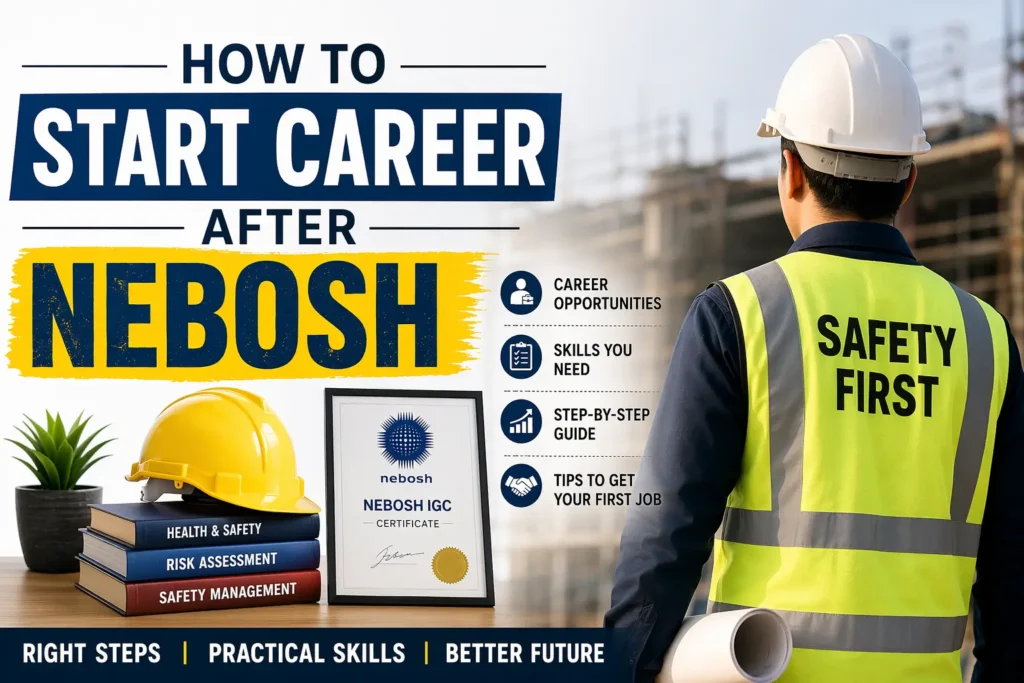
How to Start Career After NEBOSH in 2026, Complete Beginner Guide
Completing NEBOSH is a major step toward building a career in health and safety, but many candidates face the same question immediately after passing: what comes next? A certificate alone does not guarantee a job. Employers look for a combination of knowledge, practical understanding, communication skills, and the right attitude.
This guide explains exactly how to start your career after NEBOSH, even if you have no prior experience. It covers the real steps that help candidates move from certification to their first job and then grow in the industry.
Understanding What NEBOSH Really Gives You
NEBOSH provides strong theoretical knowledge of workplace safety, risk assessment, and international standards. You learn how to identify hazards, control risks, and understand legal frameworks.
However, NEBOSH does not make you job ready on its own. It gives you the foundation, not the final skill set. Employers expect you to apply this knowledge in real work situations. This is why many candidates struggle after completing the course.
To succeed, you must convert theory into practical ability.
Step 1: Choose the Right Career Path
After NEBOSH, you need clarity on where you want to work. The safety field is broad, and each sector has different requirements.
Common career options include:
- Construction safety
- Oil and gas safety
- Manufacturing safety
- Fire and industrial safety
- Environmental health and safety roles
Construction is usually the easiest entry point for freshers. Oil and gas roles offer higher salaries but often require experience.
Choose a path early so you can build relevant skills and target the right jobs.
Step 2: Build Practical Knowledge
This is where most candidates fail. They rely only on theory and do not understand how safety works on site.
You should focus on:
- Risk assessment preparation
- Job Safety Analysis (JSA)
- Permit to Work systems
- Toolbox talks
- Incident reporting and investigation
- Safety inspections
You can learn these through:
- YouTube training videos
- Safety blogs and case studies
- Sample documents and templates
- Observing real site work if possible
If you cannot get site access, study real scenarios and documents. Employers value candidates who understand practical workflows.
Step 3: Prepare a Strong Safety CV
Your CV is the first filter. Many candidates are rejected because their CV is weak or generic.
Your CV should include:
- NEBOSH certification details
- Any safety-related training
- Internship or site exposure
- Knowledge of safety systems
- Soft skills such as communication and leadership
Important tips:
- Keep it simple and professional
- Avoid copying templates blindly
- Add keywords like risk assessment, safety inspection, hazard identification
- Mention your willingness to learn and work on site
A well-written CV can significantly improve your chances of getting interview calls.
Step 4: Gain Initial Experience
The biggest challenge after NEBOSH is lack of experience. You need to overcome this barrier strategically.
Options to gain experience:
- Apply for internships or trainee roles
- Work as a site supervisor with safety responsibilities
- Join small construction companies
- Volunteer for safety-related tasks
- Assist senior safety officers
Do not focus only on salary at this stage. Your goal is to gain exposure.
Even 3 to 6 months of practical experience can make a big difference.
Step 5: Apply Smartly for Jobs
Many candidates apply randomly and get no response. You need a focused approach.
Where to apply:
- Job portals like Naukri and Indeed
- LinkedIn job listings
- Company career pages
- Recruitment agencies
- Referrals and networking
Smart strategy:
- Apply daily, not occasionally
- Customize your CV for each job
- Use proper job titles like Safety Officer, HSE Trainee
- Follow up when possible
Consistency is key. Getting the first job may take time, but persistence works.
Step 6: Prepare for Safety Interviews
Getting an interview is not enough. You must perform well.
Common interview topics:
- Risk assessment process
- Hazard identification
- Types of PPE
- Permit to Work system
- Fire safety basics
- Incident reporting
How to prepare:
- Revise NEBOSH concepts
- Practice answering clearly
- Give practical examples
- Be honest about your experience
Employers prefer candidates who understand basics clearly rather than those who give complex but unclear answers.
Step 7: Develop Soft Skills
Technical knowledge alone is not enough. Safety professionals must communicate effectively.
Key skills include:
- Communication with workers and management
- Confidence in speaking
- Observation skills
- Problem solving
- Leadership ability
You will often need to stop unsafe work, explain risks, and convince workers. These skills are critical for long term growth.
Step 8: Learn Industry-Specific Requirements
Each industry has different safety expectations.
Examples:
- Construction requires knowledge of scaffolding, excavation, and work at height
- Oil and gas focuses on permits, confined space, and process safety
- Manufacturing involves machinery safety and ergonomics
Choose your industry and go deeper into its specific risks and controls.
Step 9: Plan Your Career Growth
Once you get your first job, your next goal should be growth.
Career path example:
- Safety Trainee
- Safety Officer
- Senior Safety Officer
- HSE Engineer
- HSE Manager
To grow faster:
- Gain experience in high-risk projects
- Learn advanced safety systems
- Take additional certifications if needed
- Build strong professional network
Do not remain in the same role for years without upgrading your skills.
Common Mistakes After NEBOSH
Avoid these common errors:
- Expecting a high salary without experience
- Not applying regularly for jobs
- Ignoring practical knowledge
- Copying CVs without customization
- Losing confidence after rejection
- Not improving interview skills
Understanding these mistakes can save you time and effort.
Salary Expectations After NEBOSH
Salary depends on your location and experience.
Typical range:
- Freshers: Low starting salary or stipend
- 1 to 3 years: Moderate growth
- 3+ years: Good salary potential
- Gulf jobs: Higher salaries but require experience
Focus on learning first. Salary will improve with experience and skills.
Final Advice
Starting a career after NEBOSH is not difficult, but it requires the right approach. Many candidates fail because they rely only on the certificate and do not take action.
If you follow a clear plan, build practical knowledge, and stay consistent, you can successfully enter the safety field and grow steadily.
Remember, NEBOSH is your entry point, not your final destination. Your career depends on how you use it.
Conclusion
NEBOSH opens the door to a safety career, but walking through that door requires effort, patience, and smart decisions. Focus on gaining experience, improving skills, and applying consistently.
Your first job may not be perfect, but it is the beginning of a long and rewarding career in health and safety.
NEBOSH Course Reality, Is It Worth It in 2026
5 Shocking Reasons Why NEBOSH Holders Still Struggle in 2026
Advanced Safety Courses After NEBOSH
Is NEBOSH IDIP Worth It for Career Growth?
Diploma vs NEBOSH, Which One Actually Gets You Selected in 2026?
