 Skip to content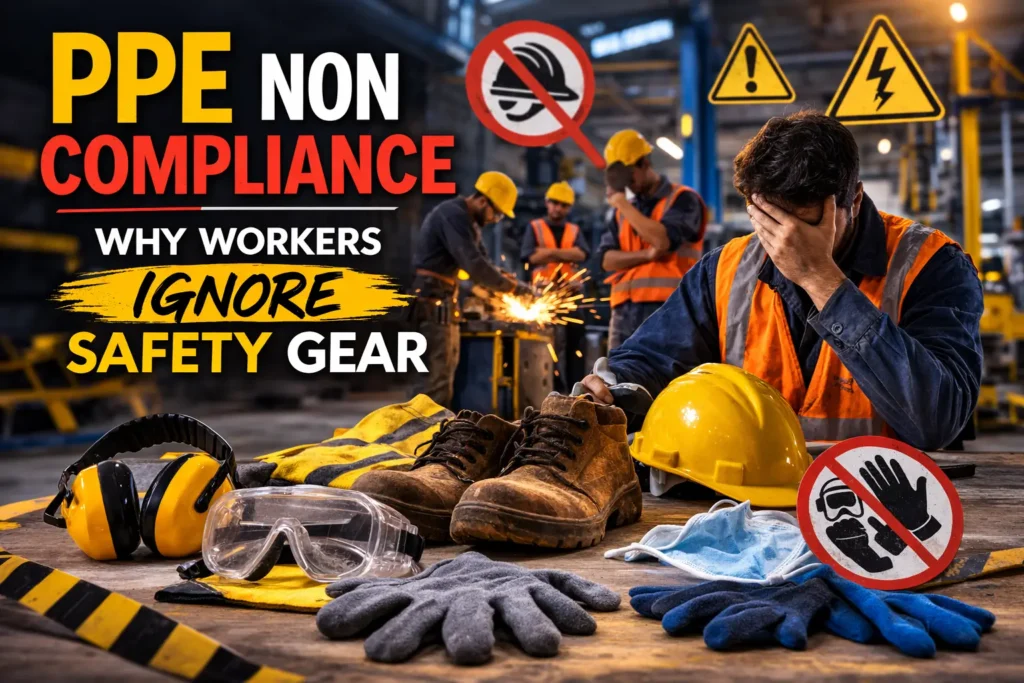
PPE Non Compliance, Why Workers Ignore Safety Gear
Let us be honest. Everyone knows that wearing safety gear is important. Hard hats protect heads. Gloves protect hands. Safety goggles protect eyes. Yet, in many workplaces, you still see workers ignoring PPE. Why?
PPE non compliance is not just a minor issue. It is a serious safety problem that leads to injuries, lost productivity, and even deaths. You might wonder, if workers know the risks, why do they still ignore safety gear?
That is exactly what we are going to explore.
What is PPE and Why It Matters
Personal Protective Equipment, commonly called PPE, includes helmets, gloves, safety shoes, ear protection, face shields, respirators, and high visibility clothing. These items are the last line of defense between a worker and a hazard.
Think of PPE like a seatbelt in a car. You do not plan to crash, but if something goes wrong, it can save your life.
Employers are legally required to provide suitable PPE. Workers are legally required to wear it. Beyond laws, it is about basic human responsibility. No job is worth losing a finger, eyesight, or life.
The Real Cost of Ignoring PPE
When PPE is ignored, accidents happen. A small metal chip can damage an eye permanently. A falling object can cause fatal head injuries. A simple chemical splash can burn skin.
But the impact does not stop there.
Companies face medical costs, compensation claims, legal penalties, and reputation damage. Production stops. Investigations begin. Morale drops. One missing helmet can cost millions.
Now ask yourself, is skipping PPE for five minutes really worth it?
Top Reasons Workers Ignore Safety Gear
Let us break down the real reasons behind PPE non compliance.
Discomfort and Poor Fit
This is one of the biggest complaints. Helmets feel heavy. Gloves reduce grip. Safety shoes feel tight. Goggles fog up.
If PPE is uncomfortable, workers naturally avoid it. It becomes a daily irritation rather than protection.
Lack of Proper Training
Sometimes workers do not fully understand the risks. If they have never experienced an injury, the danger feels distant.
Without proper training, PPE feels optional instead of essential.
Overconfidence and Risk Perception
This is the classic mindset. “I have been doing this for 10 years.” “Nothing has ever happened to me.”
Overconfidence is dangerous. Risk does not disappear just because nothing happened yesterday.
Peer Pressure and Workplace Culture
If supervisors ignore PPE, workers will follow. If experienced workers laugh at newcomers for wearing full protection, compliance drops.
Safety culture spreads just like habits. Good or bad.
Inconvenience and Time Pressure
When deadlines are tight, PPE feels like a delay. Workers think, “I will just finish this quickly.” That quick job is often when accidents happen.
Psychological Factors Behind PPE Non Compliance
The problem is not always physical. Often, it is psychological.
Habit Formation
If someone gets used to working without PPE, it becomes normal. Breaking a bad habit requires conscious effort.
Normalization of Deviance
When unsafe behavior continues without immediate consequences, it becomes accepted. Over time, people stop seeing it as risky.
Risk Compensation Theory
Some workers believe that because other safety systems exist, PPE is less important. They feel overly protected and take more risks.
Management Failures That Encourage Non Compliance
Let us not blame only workers. Management plays a major role.
Weak Supervision
If supervisors ignore violations, workers assume it is acceptable.
Inconsistent Enforcement
One day strict, next day relaxed. Mixed signals create confusion.
Poor Communication
If management fails to explain why PPE is important, workers see it as a rule, not a necessity.
Industry Examples of PPE Non Compliance
In construction, workers often remove helmets during short tasks. In manufacturing, machine operators skip gloves. In oil and gas sites, eye protection is sometimes ignored.
Every industry faces this issue. The hazards differ, but the behavior pattern is similar.
The Role of Safety Leadership
Strong leadership changes everything.
Leading by Example
If managers wear PPE during site visits, workers notice. Actions speak louder than policies.
Building a Safety Culture
Safety must become part of daily conversation. Toolbox talks, reminders, and positive reinforcement help create habits.
Strategies to Improve PPE Compliance
Now comes the practical part. How do we fix PPE non compliance?
Better PPE Selection
Choose comfortable, high quality equipment. Involve workers in selection. When they feel heard, compliance improves.
Training and Awareness Programs
Use real accident case studies. Show videos. Share real stories. Make risks feel real, not theoretical.
Incentives and Disciplinary Systems
Reward safe behavior. Recognize compliant teams. At the same time, enforce rules consistently.
Behavior Based Safety Programs
Observe behaviors. Give immediate feedback. Encourage peer accountability.
Technology and Smart PPE
Technology is changing safety.
Smart helmets with sensors can detect impacts. Wearable devices can monitor fatigue. Some systems send alerts if PPE is not worn.
Technology adds another layer of protection, but it cannot replace human responsibility.
Legal Consequences of PPE Non Compliance
Non compliance can lead to heavy fines. Authorities can shut down operations. Criminal liability may arise in severe cases.
For workers, repeated violations can result in termination. For employers, negligence can mean lawsuits.
Ignoring PPE is not just risky. It is legally dangerous.
Conclusion
PPE non compliance is not simply about laziness. It is a mix of discomfort, culture, psychology, management gaps, and human behavior.
If we want safer workplaces, we must address the root causes. Comfortable equipment, strong leadership, proper training, and consistent enforcement make the difference.
At the end of the day, PPE is not just gear. It is protection. It is prevention. It is life.
The question is simple. Are we willing to risk everything for a few minutes of comfort?
PPE Fails Caught on Camera: What NOT to Do as a Safety Officer
Hard Hat Standards Explained: ANSI vs. EN
Safety Harness: Full Body vs Chest Harness – When to Use Each?
Hard Hats: Type I vs Type II – Which Offers Better Protection?
PPE vs Engineering Controls – Which is More Effective?
FAQs
1. What is the main reason for PPE non compliance?
Discomfort and poor safety culture are the most common reasons. Workers often avoid PPE if it feels inconvenient or unnecessary.
2. How can employers improve PPE compliance?
By providing proper training, selecting comfortable PPE, leading by example, and enforcing rules consistently.
3. Is PPE the only safety measure required?
No. PPE is the last line of defense. Engineering and administrative controls should come first.
4. Can workers be penalized for not wearing PPE?
Yes. In many workplaces, repeated violations can lead to disciplinary action or termination.
5. Does technology help improve PPE compliance?
Yes. Smart PPE and monitoring systems can track usage and provide alerts, helping improve compliance rates.
