 Skip to content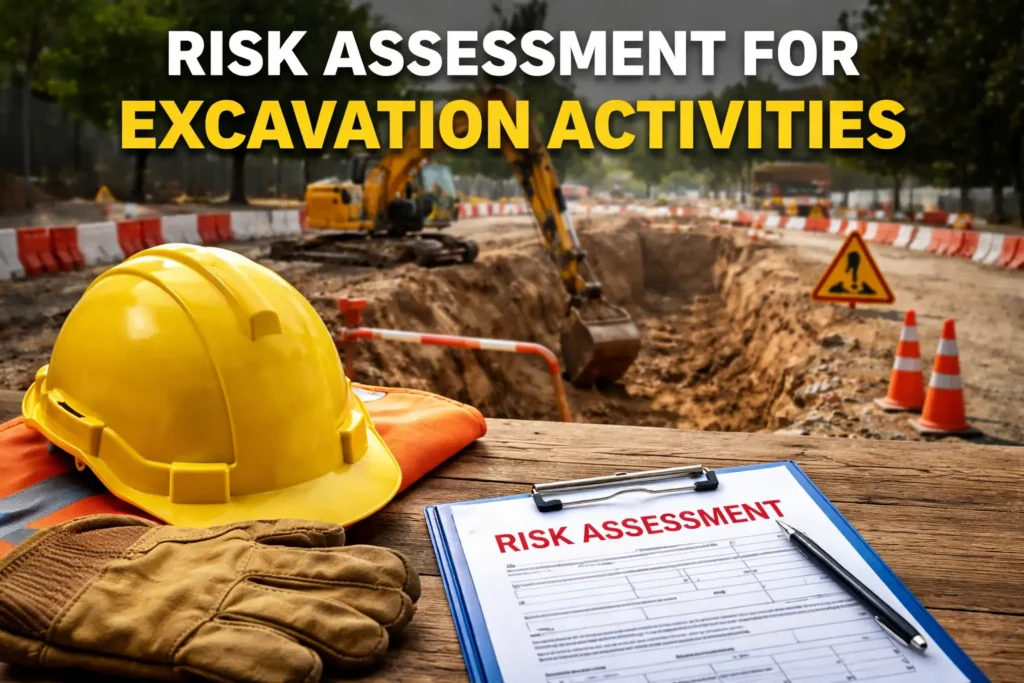
Risk Assessment for Excavation Activities
What is Excavation Work?
Excavation work is one of the most essential activities in construction, yet it remains one of the most hazardous. It involves removing soil, rock, or other materials to create space for foundations, pipelines, drainage systems, or underground utilities. At first glance, it may seem like a routine construction task, but once you start digging, you are dealing with unpredictable ground conditions that can change within minutes.
Imagine standing inside a trench surrounded by soil walls. Everything looks stable, but beneath the surface, there may be loose soil layers, water seepage, or hidden utilities. This is exactly why excavation work is risky. The moment the natural balance of the ground is disturbed, it creates conditions where collapse, slips, or structural failures can happen suddenly.
Whether it is shallow trenching or deep basement excavation, every activity carries its own set of hazards. That is why proper planning and risk assessment are not optional. They are absolutely necessary to ensure worker safety and project success.
Why Risk Assessment is Critical in Excavation
Risk assessment acts like a safety roadmap for excavation work. Without it, workers are exposed to dangers that are often invisible until it is too late. Excavation accidents, especially trench collapses, can occur within seconds and often result in serious injuries or fatalities.
A single cubic meter of soil can weigh more than a small car. Now imagine that weight collapsing onto a worker. It leaves almost no chance for survival. This is not an exaggeration, it is the reality of excavation hazards.
By conducting a proper risk assessment, you identify potential hazards in advance, evaluate their severity, and implement control measures to reduce risks. It helps ensure compliance with safety regulations, improves site coordination, and builds a proactive safety culture. In simple terms, risk assessment turns excavation from a dangerous activity into a controlled and manageable process.
Understanding Excavation Hazards
Common Hazards in Excavation Activities
Excavation hazards come in many forms, and not all of them are obvious. Some are visible, like open pits and moving machinery, while others remain hidden underground. This combination makes excavation work particularly dangerous.
The most common hazards include trench collapses, falling materials, underground utility strikes, hazardous atmospheres, water accumulation, and equipment-related accidents. Among all these, trench collapse is the most dangerous and deadly hazard. It can occur without warning and trap workers instantly.
Another serious risk is contact with underground utilities such as gas pipelines or electrical cables. A single mistake during digging can lead to explosions, fires, or electrocution. Similarly, water accumulation weakens soil structure, increasing the chances of collapse.
These hazards highlight the importance of identifying risks before starting work. Ignoring even one factor can lead to severe consequences.
Real Statistics and Accident Trends
Excavation-related accidents continue to be a major concern in the construction industry. Many incidents are linked to poor planning, lack of supervision, and failure to implement protective systems. In most cases, investigations reveal that basic safety practices were ignored.
A large number of accidents occur because workers enter unprotected trenches or because proper shoring systems are not installed. Another common issue is failure to identify underground utilities before excavation begins.
What is surprising is that most of these accidents are preventable. With proper risk assessment and control measures, the majority of excavation-related incidents can be avoided. This clearly shows that the problem is not the activity itself, but how it is managed.
Types of Excavation Activities
Trenching and Deep Excavation
Trenching is a narrow type of excavation where the depth is greater than the width. It is commonly used for laying pipelines, cables, and drainage systems. Despite being common, trenching is extremely dangerous due to the high risk of collapse.
As the depth increases, the pressure on trench walls also increases. If proper support systems like shoring or trench boxes are not used, the walls can collapse suddenly. Even a small trench can become deadly if safety measures are ignored.
Deep excavations require advanced planning, soil testing, and continuous monitoring. Without these, the risk level increases significantly.
Basement and Foundation Excavation
Basement and foundation excavations are usually wider and deeper compared to trenching. These are commonly seen in building construction projects. The main challenge here is maintaining the stability of surrounding structures.
Excavation near existing buildings can cause soil movement and structural damage. If not properly managed, it can lead to cracks, settlement, or even collapse of nearby structures.
This type of excavation requires detailed risk assessment, including structural analysis, soil conditions, and load distribution. Proper planning ensures both worker safety and structural integrity.
Step-by-Step Risk Assessment Process
Hazard Identification
Hazard identification is the first and most critical step in risk assessment. It involves identifying all possible risks associated with excavation work. This includes both visible hazards and hidden dangers.
Factors such as soil type, excavation depth, weather conditions, nearby structures, underground utilities, and equipment must be considered. A thorough inspection of the site helps in identifying potential hazards before work begins.
Missing even a single hazard can lead to serious consequences. That is why this step requires careful attention and expertise.
Risk Evaluation and Rating
After identifying hazards, the next step is to evaluate the risk level. This involves analyzing how likely the hazard is to occur and how severe its impact could be.
For example, a trench collapse may not happen frequently, but if it does, the consequences are severe. This makes it a high-risk hazard that requires immediate control measures.
Risk evaluation helps prioritize hazards and focus on the most critical risks first.
Control Measures Implementation
Once risks are evaluated, appropriate control measures must be implemented. These measures aim to eliminate or reduce risks to an acceptable level.
Control measures may include installing trench supports, using protective barriers, providing safe access points, and conducting regular inspections. The effectiveness of these measures depends on proper implementation and supervision.
Monitoring and Review
Risk assessment is not a one-time activity. Excavation conditions can change rapidly due to weather, soil movement, or ongoing work.
Regular monitoring ensures that control measures remain effective. Inspections should be carried out daily and after any major changes. Continuous review helps in identifying new hazards and updating safety measures accordingly.
Excavation Risk Assessment Table
| Hazard | Risk Level | Possible Consequences | Control Measures |
|---|---|---|---|
| Cave-in | High | Fatal injury, burial | Shoring, shielding, sloping |
| Falling objects | Medium | Head injury | Hard hats, barricades |
| Utility strike | High | Explosion, electrocution | Utility mapping, permits |
| Water accumulation | High | Collapse, drowning | Dewatering systems |
| Hazardous gases | High | Suffocation | Gas monitoring, ventilation |
| Falls into trench | Medium | Fractures | Guardrails, signage |
Control Measures for Excavation Risks
Engineering Controls
Engineering controls are the most effective way to manage excavation risks because they directly address the source of hazards. These include sloping, benching, shoring systems, and trench boxes.
Proper engineering controls ensure that excavation walls remain stable and reduce the chances of collapse. They also include systems to manage water and provide safe access for workers.
Administrative Controls
Administrative controls focus on procedures and management practices. These include permit systems, safety training, supervision, and regular inspections.
These measures ensure that safety rules are followed consistently and that workers are aware of potential hazards.
PPE Requirements
Personal Protective Equipment provides an additional layer of protection. Workers should wear safety helmets, high-visibility vests, safety shoes, and gloves.
While PPE is important, it should always be used along with other control measures, not as a replacement.
Legal Requirements and Safety Standards
OSHA and International Standards
Excavation work is regulated by strict safety standards to protect workers. These standards require protective systems for deep excavations, regular inspections, and supervision by a competent person.
Compliance with these regulations ensures a safe working environment and reduces the risk of accidents.
Role of Competent Person in Excavation Safety
A competent person plays a vital role in ensuring excavation safety. This individual is responsible for identifying hazards, assessing risks, and taking immediate action to correct unsafe conditions.
They must have the authority to stop work if necessary and ensure that all safety measures are properly implemented.
Emergency Preparedness for Excavation Work
Emergency preparedness is essential in excavation work. Despite all precautions, unexpected incidents can still occur.
An effective emergency plan includes rescue procedures, first aid availability, communication systems, and trained personnel. Quick response can significantly reduce the severity of accidents.
Common Mistakes in Excavation Risk Assessment
Many accidents occur due to simple mistakes such as ignoring soil conditions, skipping utility checks, not updating risk assessments, and lack of supervision.
These mistakes are avoidable and highlight the importance of proper planning and awareness.
Best Practices for Safe Excavation Work
Safe excavation requires a combination of planning, supervision, and discipline. Regular inspections, proper use of protective systems, and continuous monitoring are essential.
Maintaining safe distances for spoil piles, ensuring proper drainage, and conducting toolbox talks also contribute to a safer work environment.
Conclusion
Risk assessment for excavation activities is a critical process that ensures worker safety and project success. By identifying hazards, evaluating risks, and implementing control measures, excavation work can be carried out safely and efficiently.
Difference Between HIRA JSA and Risk Assessment
5 Levels of Risk Control (Hierarchy of Controls) Explained
How to Conduct a Workplace Risk Assessment (Step-by-Step Guide)
Permit to Work System vs Risk Assessment
JSA vs JHA: Job Safety Analysis vs Job Hazard Analysis
FAQs
1. What is the biggest risk in excavation work?
Trench collapse is the most dangerous risk and can lead to fatal injuries.
2. When is trench protection required?
When excavation depth exceeds 1.5 meters or soil conditions are unstable.
3. Who is responsible for excavation safety?
A competent person is responsible for ensuring safety on site.
4. How often should inspections be conducted?
Daily and after any major changes in conditions.
5. What PPE is required for excavation work?
Helmet, safety shoes, gloves, and high-visibility vest.
