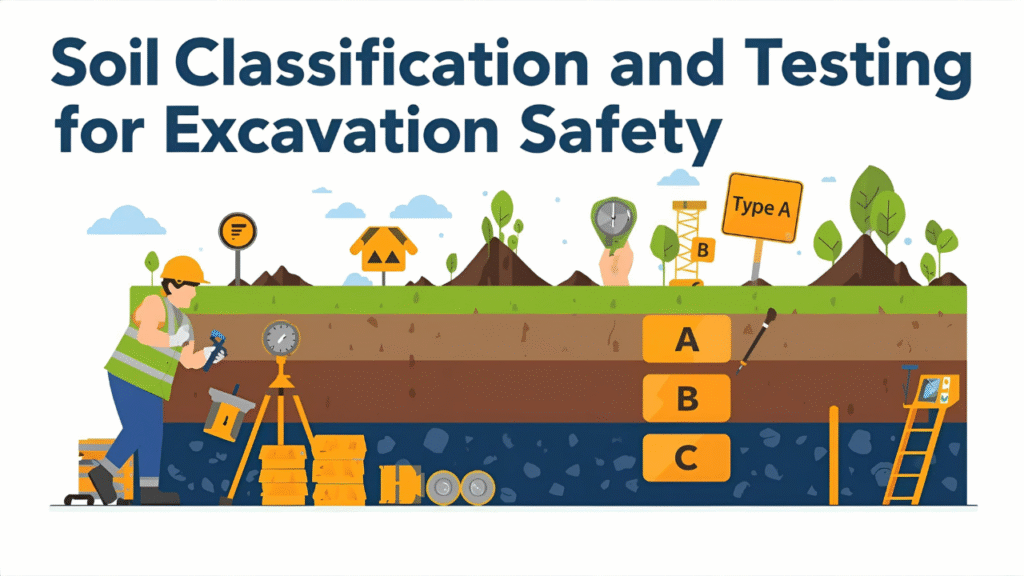
Soil Classification and Testing for Excavation Safety
Soil behavior determines the structural stability of any excavation. Understanding soil classification and testing is essential for preventing cave-ins — the most fatal hazard in excavation work. Proper soil evaluation helps determine whether the site needs sloping, benching, shoring, or shielding.
This article explains soil types, field testing procedures, and key safety practices for excavation professionals.
Why Soil Classification Matters in Excavation
- Determines wall stability
- Identifies collapse risk
- Guides protective system choice
- Enables safe trench design
- Supports compliance with OSHA & HSE regulations
Correct soil identification can be the difference between a safe work zone and a deadly collapse.
Soil Classification System
Soil is categorized based on cohesion, compressive strength, moisture, and stability.
1. Stable Rock
- Solid mineral rock
- No soil movement
- Most stable excavation material
Allows near-vertical cuts without support.
2. Type A Soil (Most Stable — Cohesive Clay)
- Clay
- Silty clay
- Clay-loam
- Hardpan
Unconfined compressive strength ≥ 1.5 tons/ft²
Highly cohesive and strong.
3. Type B Soil (Medium Stability)
- Angular gravel
- Silt
- Silt-loam
- Previously disturbed soils
Unconfined compressive strength: 0.5 – 1.5 tons/ft²
Moderately cohesive.
4. Type C Soil (Least Stable)
- Sand
- Gravel
- Submerged soil
- Soil with water seepage
- Loose particulate materials
Unconfined compressive strength ≤ 0.5 tons/ft²
Collapse risk is high.
Visual Soil Identification (Field Clues)
Cohesive soil:
- Molds into shapes when squeezed
- Holds form
- Slower drainage
Granular soil:
- Crumbles easily
- Cannot hold shape
- Water drains quickly
These visual clues are preliminary — scientific tests confirm results.
Soil Testing Methods for Excavation Safety
OSHA recommends at least one test for accurate classification.
1. Manual Tests
Ribbon/Thread Test
Roll wet soil into ribbons — cohesive clay forms longer ribbons.
Pocket Penetrometer Test
Measures compressive strength using a gauge.
Thumb Test
If thumb penetrates soil easily → Type C
If thumb barely penetrates → Type A
2. Laboratory Analysis
Moisture Content Test
Determines water influence on cohesion.
Grain Size Analysis
Classifies soil particles.
Atterberg Limits Test
Measures plasticity & shrink-swell characteristics.
3. Environmental Observations
- Signs of water seepage
- Vibrations nearby
- Construction history
- Soil layering
- Weather effects
Soil is dynamic — conditions can change daily.
Factors Affecting Soil Stability
- Moisture level
- Vibration (traffic/machinery)
- Adjacent structures
- Load near trench edge
- Time exposure
- Temperature & weather
Protective Systems Based on Soil Type
Depending on classification:
Stable Rock:
May allow vertical walls.
Type A:
Mild sloping or benching often sufficient.
Type B:
Requires steeper slope or shoring support.
Type C:
Must use:
- Shoring
- Shielding
- Maximum slope angle
Type C soil collapses quickly — never leave vertical walls.
Inspection Requirements
A competent person must:
- Inspect soils daily
- Re-evaluate after rain or moisture changes
- Record findings
- Approve entry
- Stop work if soil conditions are unsafe
Field-tested soil results should be documented.
Signs of Impending Soil Failure
- Cracking or slumping
- Bulging trench walls
- Water seepage
- Falling soil fragments
- Settlement or ground shifting
- Sudden changes after vibration
If any warning sign appears — evacuate immediately.
Safety Best Practices
- Always test soil before excavation
- Use trench protection systems
- Train workers on soil types
- Keep spoil piles 2 ft away
- Monitor moisture after rainfall
- Use trench shields in loose soils
- Never work alone inside a trench
Conclusion
Soil classification is the foundation of excavation safety. By identifying soil type, performing proper testing, and applying the correct protective systems, excavation hazards can be significantly reduced. Safety begins beneath the surface — with an informed understanding of soil behavior.
For checklist and templates visit The HSE Tools.
What Is Excavation Work? Definition, Types, and Safety Controls
Safety Precautions for Excavation and Trenching Work
Top 50 Excavation & Trenching Safety Interview Questions and Answers
Excavation Safety Interview: 50 Questions and Sample Answers
FAQs
1. Who is responsible for soil testing on site?
A designated competent person trained in soil analysis.
2. How often should soil conditions be checked?
Before each shift and after significant weather changes.
3. Can soil change classification during work?
Yes — moisture, vibration, and time can alter soil stability.
4. Which soil type is most dangerous?
Type C soil, due to very low cohesion.
5. Is lab testing required for excavation safety?
Not mandatory — field tests often suffice — but lab tests provide deeper accuracy.
