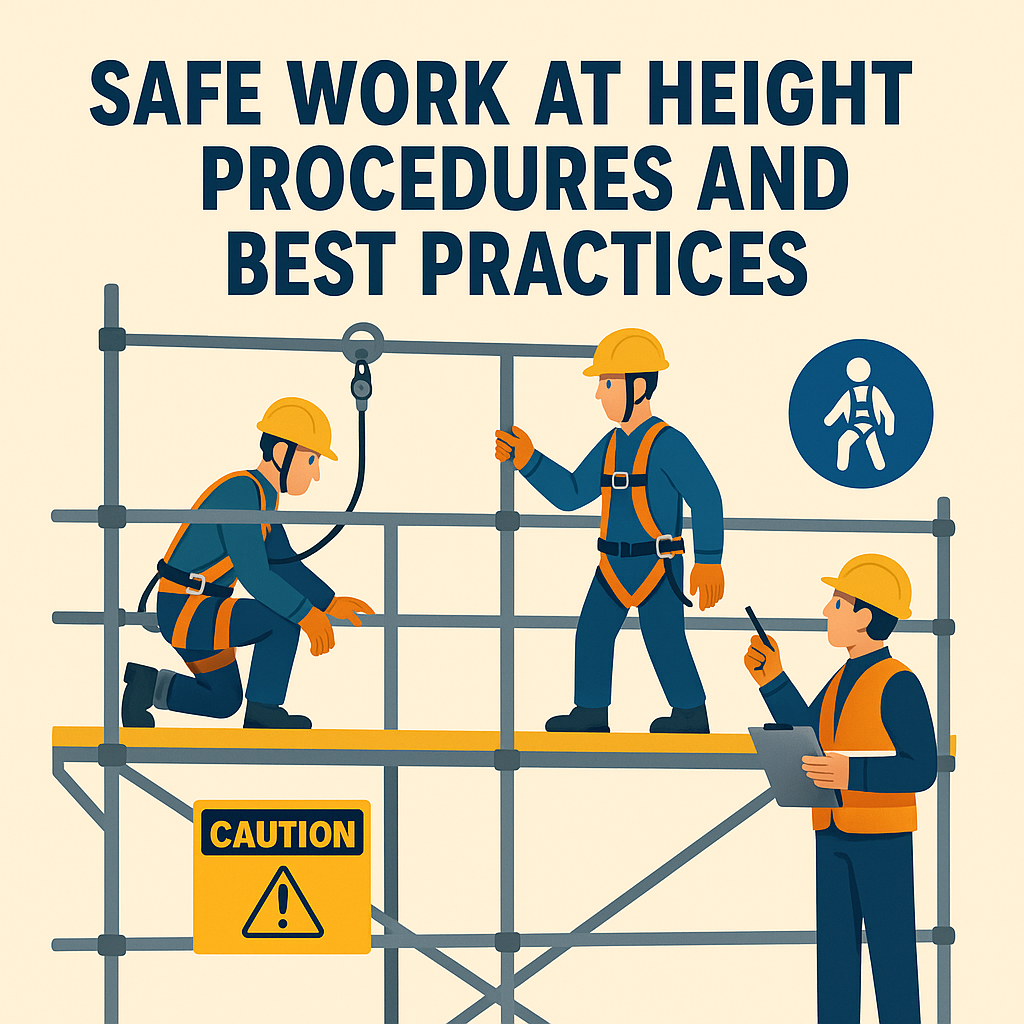
Safe Work at Height Procedures and Best Practices
Working at height continues to be one of the leading causes of workplace fatalities around the world. Whether it involves scaffolding, ladders, rooftops, mobile elevating work platforms (MEWPs), or structural steel work, even a fall from a short height can lead to serious injury or death. To prevent such incidents, organizations must implement Safe Work at Height Procedures backed by strong planning, supervision, equipment control, and worker training.
This article provides a complete guide to hazard identification, fall prevention methods, PPE requirements, rescue plans, and best practices for safe work at height in industrial and construction environments.
What Is Work at Height?
Work at height refers to any job performed:
- At a place where a person could fall and injure themselves
- Above ground level
- Near edges, openings, or fragile surfaces
- Below ground (e.g., pits) where a fall risk exists
Examples include:
- Scaffolds
- Ladders
- Roofs
- Tanks
- MEWPs
- Steel structures
- Open floors
If a fall risk exists, work at height rules apply.
Why Safe Work at Height Procedures Are Important
Falls from height occur due to:
- Poor planning
- Incorrect equipment
- Lack of supervision
- Weather conditions
- Improper PPE
- Unsafe scaffolding
- Worker error
Safe procedures reduce risk by ensuring:
- Hazards are controlled
- Systems are in place
- Workers are competent
- Work is monitored
A single mistake can be fatal.
Hazard Identification for Work at Height
Before any height activity, hazards must be identified:
Unprotected Edges
Edges without guardrails pose the highest risk.
Fragile Surfaces
Roofs, skylights, and old platforms can collapse.
Improper Scaffolding
Defects or missing components lead to collapse.
Loose or Unstable Ladders
Poor positioning or wrong ladder type causes falls.
Falling Objects
Tools or materials can strike workers below.
Weather Conditions
Wind, rain, snow, and heat increase fall risk.
Improper PPE
Missing or damaged harnesses can lead to fatal falls.
Once hazards are identified, proper controls must be implemented.
Hierarchy of Controls for Work at Height
Fall control measures must follow the hierarchy:
Avoid the Work at Height
Use drones, long-handled tools, or work from the ground.
Prevent Falls
Install guardrails, platforms, scaffolds, and barriers.
Minimize Fall Distance and Impact
Use fall arrest systems, harnesses, and lifelines.
Administrative Controls
Training, supervision, permits, and procedures.
PPE
Harness, lanyard, helmets — last line of defense.
Safe Work at Height Planning
Planning begins long before the worker climbs.
Site Assessment
Identify all fall hazards.
Risk Assessment
Evaluate likelihood and severity of falls.
Permit to Work System
Ensures only authorized and competent persons perform height work.
Selection of Equipment
Choose the right scaffold, ladder, MEWP, or platform.
Emergency and Rescue Plan
Must be in place before work starts.
Proper planning prevents accidents.
Fall Protection Systems
Work at height safety relies on multiple fall protection systems.
Collective Protection Systems
Guardrails
Primary method for preventing falls.
Toe Boards
Prevent tools from falling.
Scaffold Platforms
Provide safe working surfaces.
Safety Nets
Reduce injury in case of falls.
Personal Fall Protection Systems
Used when collective measures are not feasible.
Fall Arrest Systems
Stop a worker after falling.
Includes:
- Full-body harness
- Shock-absorbing lanyard
- Retractable lifeline (SRL)
Positioning Systems
Hold worker securely in place.
Restraint Systems
Prevent the worker from reaching an edge.
Rope Access Systems
Used in technical work at extreme heights.
Scaffolding Safety Procedures
Scaffolding is often used in construction and maintenance.
Scaffold Requirements
- Erected by trained and certified personnel
- Inspected before use
- Proper planks and platforms
- Guardrails and toe boards
- Stable foundation
Common Scaffold Hazards
- Collapse
- Overloading
- Missing components
- Poor access
Daily Inspections
Required and documented.
Ladder Safety Procedures
Ladders are often misused.
Correct Ladder Selection
Choose:
- Step ladder
- Extension ladder
- Platform ladder
Based on task.
Positioning Rules
- 4:1 angle for extension ladders
- Secure top and bottom
- Maintain three-point contact
Prohibited Practices
- Overreaching
- Standing on top steps
- Using metal ladders near electricity
Workers must be trained in ladder safety.
Working on Roofs
Roofs present high fall risks.
Key Controls
- Edge protection
- Skylight covers
- Fragile roof identification
- Safety harness with anchor points
Weather Conditions
Do not work during:
- Rain
- Snow
- High winds
Roofs require increased supervision.
Work Platforms and MEWPs
Mobile Elevated Work Platforms must be used correctly.
MEWP Requirements
- Operated only by certified personnel
- Outriggers deployed
- Guardrails intact
- Surface conditions inspected
Common MEWP Hazards
- Tip-over
- Crushing
- Electrical contact
PPE for MEWP Work
- Harness with short lanyard
- Fixed anchorage inside basket
Tool and Material Fall Prevention
Falling objects are a major hazard.
Prevention Methods
- Toe boards
- Tool lanyards
- Material nets
- Barricading below the work area
Workers Below
Must wear helmets at all times.
Work at Height PPE Requirements
Workers must use:
Full-Body Harness
Must be certified and inspected.
Shock-Absorbing Lanyard
Controls deceleration.
Self-Retracting Lifeline (SRL)
Ideal for vertical movement.
Safety Helmet with Chin Strap
Prevents helmet from falling during impact.
Non-Slip Safety Boots
Provide grip and stability.
PPE must be worn correctly at all times.
Inspection Requirements for Height Equipment
Daily Pre-Use Inspection
Workers must inspect:
- Harness condition
- Webbing damage
- Buckles and stitching
- Lanyard condition
- SRL retraction
- Anchor points
Formal Annual Inspection
Performed by certified inspector.
Faulty equipment must be removed immediately.
Weather Considerations
Work at height should be postponed during:
- High winds
- Heavy rain
- Lightning
- Snow or ice
- Extreme heat
Environmental conditions must be constantly monitored.
Communication and Supervision
Effective Communication
Personnel must use:
- Radios
- Hand signals
- Visual checks
Supervision
A competent person must supervise:
- High-risk tasks
- Scaffold erection
- MEWP operations
- Roof work
Supervision ensures safe practices are maintained.
Emergency Response and Rescue Plan
A rescue plan is mandatory.
Rescue Methods
- Lowering the worker to ground
- Raising the worker via retrieval system
- Using MEWPs
- Rope rescue
Rescue Equipment
- Tripod/winch
- Suspension trauma straps
- First aid equipment
All workers must be trained in emergency response.
Common Causes of Falls from Height
Work at height incidents often result from:
- Lack of planning
- Incorrect equipment
- Failure to use PPE
- Poor workmanship
- Ignoring weather risks
- Overreaching on ladders
- Faulty scaffolding
Understanding these causes helps prevent them.
Best Practices for Safe Work at Height
Plan every activity in advance
Permit-to-work, rescue plan, equipment selection.
Always use fall protection
Never work unprotected near edges.
Inspect equipment daily
PPE checks save lives.
Train workers regularly
Competency reduces human error.
Supervise high-risk tasks
Prevent unsafe behavior.
Remove unauthorized personnel
Restrict access to work at height zones.
Conclusion
Safe work at height depends on careful planning, proper equipment, trained personnel, and strong supervision. Falls from height are preventable when organizations implement structured procedures supported by fall protection systems and continuous monitoring.
Every worker at height deserves full protection — and every employer must ensure procedures are followed without exception.
Work at height is dangerous, but with the right controls, it can be done safely.
For checklist and templates visit The HSE Tools.
Fall Protection Measures at Construction Sites
Scaffolding Safety Interview Questions and Answers
Slip, Trip, and Fall Prevention Strategies
How to Calculate Fall Distance OSHA
Work at Height Safety Interview: 50 Questions and Sample Answers
FAQs
1. What height is considered “work at height”?
Any place where a person could fall and be injured, typically above ground level.
2. Is a harness always required?
Yes, unless collective protections like guardrails eliminate the fall risk.
3. Who can erect scaffolding?
Only trained and certified scaffolders.
4. When should work at height stop?
During bad weather, poor visibility, or equipment failure.
5. What is the safest fall protection method?
Collective protection like guardrails or platforms, followed by personal fall arrest systems.
