 Skip to content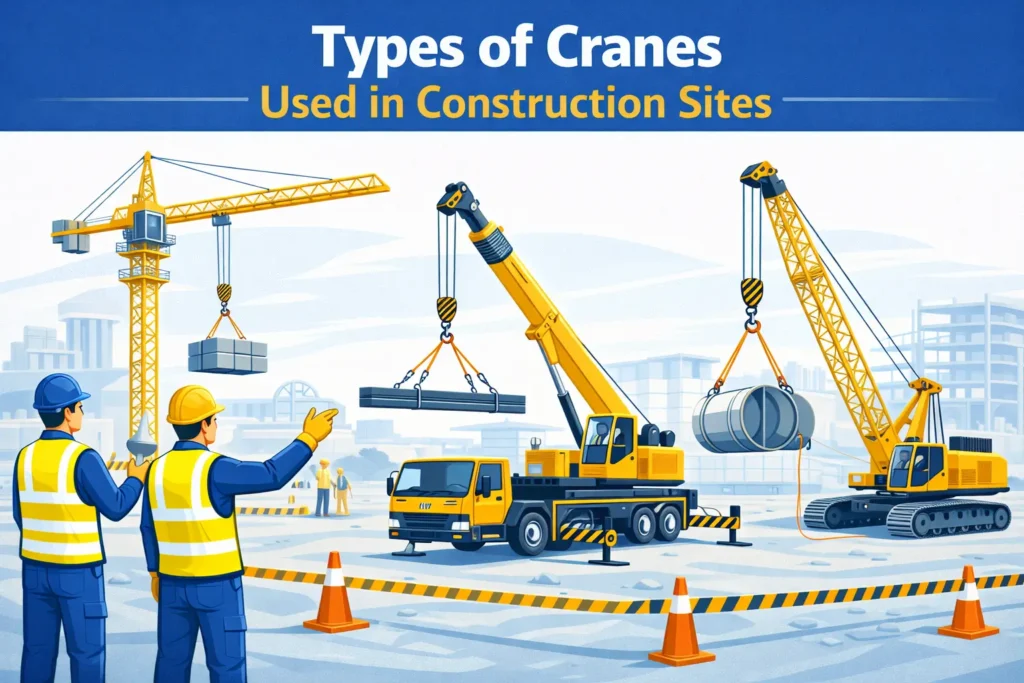
Types of Cranes Used in Construction Sites
Learn about the different types of cranes used in construction sites, their applications, advantages, limitations, and safety considerations for lifting operations.
Cranes are indispensable machines in modern construction projects. From high-rise buildings and bridges to industrial plants and infrastructure projects, cranes enable the lifting, lowering, and movement of heavy materials that would otherwise be impossible or unsafe to handle manually. The choice of crane plays a major role in project efficiency, safety, cost control, and timely completion.
There are many types of cranes used in construction sites, each designed for specific lifting requirements, site conditions, and load capacities. Selecting the wrong crane can lead to delays, increased costs, and serious safety risks. Therefore, understanding crane types, their applications, and limitations is essential for engineers, supervisors, safety officers, and lifting planners.
This article provides a detailed explanation of the main types of cranes used in construction, along with their uses, advantages, and safety considerations.
Why Different Types of Cranes Are Used in Construction
Construction sites vary greatly in size, layout, terrain, and lifting demands. Different cranes are required because:
- Load weights and dimensions vary
- Site access may be limited
- Ground conditions differ
- Lift heights and reach requirements change
- Project duration and mobility needs vary
Using the correct crane improves productivity and reduces lifting risks.
International safety regulations such as OSHA Cranes and Derricks in Construction provide detailed requirements for crane selection, operation, and lifting safety.
Factors Influencing Crane Selection
Before selecting a crane, the following factors are considered:
- Load weight and size
- Lift height and radius
- Site space and access
- Ground bearing capacity
- Duration of project
- Environmental conditions
- Safety and regulatory requirements
Crane selection must always be supported by a lifting plan and risk assessment.
Mobile Cranes
Truck-Mounted Cranes
Description
Truck-mounted cranes are mounted on a commercial truck chassis. They are highly mobile and can travel easily between sites.
Applications
- Short-term lifting tasks
- Roadside construction
- Utility installation
- Material loading and unloading
Advantages
- High mobility
- Quick setup
- Suitable for urban areas
Limitations
- Limited lifting capacity compared to larger cranes
- Requires stable ground for outriggers
Rough Terrain Cranes
Description
Rough terrain cranes are designed for off-road and uneven ground conditions. They have large rubber tires and powerful engines.
Applications
- Construction sites with rough ground
- Industrial projects
- Oil and gas facilities
Advantages
- Excellent maneuverability on uneven terrain
- High lifting capacity for their size
Limitations
- Limited road travel capability
- Requires transportation between sites
All-Terrain Cranes
Description
All-terrain cranes combine features of truck-mounted and rough terrain cranes. They can travel on highways and operate on rough sites.
Applications
- Large construction projects
- Power plants
- Infrastructure works
Advantages
- High mobility and versatility
- High lifting capacity
Limitations
- High purchase and operating cost
- Requires skilled operators
Crawler Cranes
Description
Crawler cranes move on tracks instead of wheels, providing excellent stability and load distribution.
Applications
- Heavy lifting
- Long-term projects
- Bridge construction
- Industrial installations
Advantages
- Very high lifting capacity
- Stable on soft ground
- Can move with load
Limitations
- Slow movement
- Requires dismantling for transport
Tower Cranes
Hammerhead Tower Cranes
Description
Hammerhead cranes have a horizontal jib fixed at one height with a trolley that moves the load.
Applications
- High-rise building construction
- Dense urban sites
Advantages
- Excellent lifting height
- Wide coverage area
- Precise load control
Limitations
- Fixed height
- Complex installation and dismantling
Luffing Jib Tower Cranes
Description
Luffing jib cranes have a jib that can be raised or lowered, making them ideal for restricted spaces.
Applications
- City centers
- Sites with limited airspace
Advantages
- Minimal swing radius
- Suitable for congested sites
Limitations
- Slower operation
- Higher operational complexity
Self-Erecting Tower Cranes
Description
These are compact tower cranes that can be assembled without additional cranes.
Applications
- Small to medium projects
- Residential buildings
Advantages
- Quick installation
- Lower setup cost
Limitations
- Limited lifting capacity
- Limited height
Overhead and Gantry Cranes
Overhead Cranes
Description
Overhead cranes run on rails installed on building structures.
Applications
- Factories
- Warehouses
- Assembly plants
Advantages
- Precise material handling
- Efficient indoor operation
Limitations
- Fixed installation
- Not suitable for outdoor construction
Gantry Cranes
Description
Gantry cranes are similar to overhead cranes but supported by legs that move on rails.
Applications
- Shipyards
- Precast yards
- Container handling
Advantages
- High load capacity
- Flexible movement
Limitations
- Requires dedicated rail system
- Large footprint
Loader Cranes (Knuckle Boom Cranes)
Description
Loader cranes are compact cranes mounted on trucks, commonly used for loading materials.
Applications
- Material delivery
- Utility work
- Light construction
Advantages
- Compact design
- Quick loading and unloading
Limitations
- Limited lifting height
- Lower capacity
Pick and Carry Cranes
Description
Pick and carry cranes are mobile cranes capable of lifting and transporting loads over short distances.
Applications
- Industrial plants
- Fabrication yards
Advantages
- No outriggers required
- Fast material movement
Limitations
- Limited lifting capacity
- Not suitable for uneven ground
Floating Cranes
Description
Floating cranes are mounted on barges and used for marine construction.
Applications
- Bridge construction
- Port development
- Offshore projects
Advantages
- Extremely high lifting capacity
- Suitable for water-based projects
Limitations
- Limited to water access
- Weather dependent
Special Purpose Cranes
Telescopic Cranes
Description
Telescopic cranes use extendable booms for flexible reach.
Applications
- Urban construction
- Maintenance work
Advantages
- Adjustable boom length
- Fast setup
Limitations
- Reduced capacity at extended reach
Railway Cranes
Description
Railway cranes operate on rail tracks for maintenance and construction.
Applications
- Railway infrastructure
- Track maintenance
Advantages
- Stable rail-based operation
- Efficient for rail projects
Limitations
- Restricted to rail lines
Safety Considerations for All Crane Types
Operator Competency
- Operators must be certified
- Regular refresher training required
Lifting Plan and Risk Assessment
- Mandatory for all lifts
- Essential for critical lifts
Load Management
- Never exceed rated capacity
- Consider radius and configuration
Ground and Environmental Conditions
- Assess soil bearing capacity
- Monitor wind and weather
Communication and Supervision
- Appoint a signalman
- Maintain clear communication
Common Mistakes in Crane Selection
- Choosing crane based only on availability
- Ignoring ground conditions
- Underestimating load weight
- Lack of safety planning
Proper planning avoids these mistakes.
Best Practices for Crane Usage in Construction
- Select crane based on engineering assessment
- Use manufacturer load charts
- Conduct pre-lift meetings
- Monitor lifting operations continuously
Conclusion
Understanding the types of cranes used in construction sites is essential for safe and efficient lifting operations. Each crane type is designed for specific applications, and selecting the right crane reduces risks, improves productivity, and ensures compliance with safety regulations.
Successful construction projects rely not just on powerful equipment, but on correct selection, planning, and safe operation of cranes.
Safe Lifting Practices and Planning for Cranes
Scaffold Mock Drill: Scaffold Collapse Scenario Response
Scaffold Safety Audit Procedure
Scaffold HIRA with Example Controls
Common Scaffolding Hazards and Control Measures
FAQs
1. Which crane is most commonly used in construction?
Mobile cranes and tower cranes are the most commonly used.
2. What crane is used for high-rise buildings?
Tower cranes are ideal for high-rise construction.
3. Which crane is suitable for heavy lifting?
Crawler cranes and floating cranes are used for heavy lifts.
4. Are lifting plans required for all cranes?
Yes, all crane operations require planning and risk assessment.
5. Who decides which crane to use on site?
Engineers and lifting supervisors based on technical and safety requirements.
