 Skip to content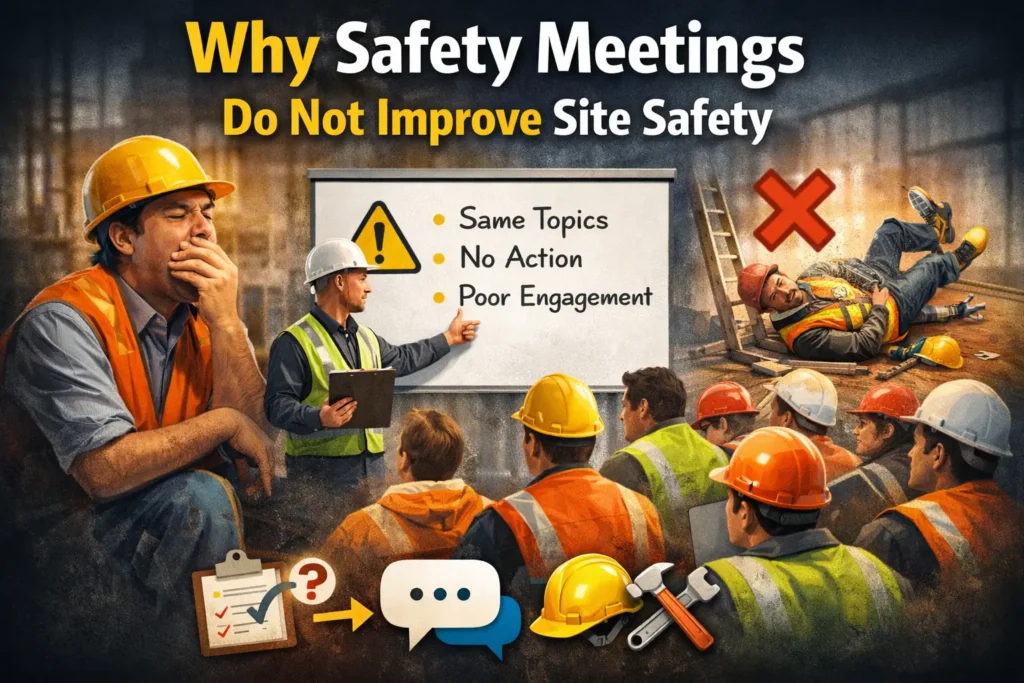
Why Safety Meetings Do Not Improve Site Safety
Safety meetings, including toolbox talks and daily briefings, are designed to create awareness about hazards, reinforce safety rules, and prepare workers for tasks. In theory, they are one of the most powerful tools to prevent accidents.
They give safety officers an opportunity to communicate risks, explain procedures, and guide workers before work begins.
The Reality on Site
But in many workplaces, safety meetings do not improve safety. Workers attend, listen, and leave, but their behavior does not change. Accidents still happen, and the same mistakes repeat.
This raises an important question. If safety meetings are so important, why are they not effective?
The Biggest Misconception About Safety Meetings
Talking Equals Safety
The biggest misconception is that talking about safety automatically improves safety. Many organizations believe that conducting meetings regularly is enough.
But safety is not about talking, it is about action. Without implementation, meetings have no impact.
Reason 1: Meetings Are Treated as Formality
Attendance Over Engagement
In many sites, safety meetings are treated as a formality. Attendance is taken, signatures are collected, and the meeting is considered complete.
But real engagement is missing. Workers attend physically, but mentally they are disconnected.
Reason 2: Lack of Practical Content
Theory Without Application
Many safety meetings focus on theory rather than real site conditions. Topics are generic and not related to the actual work being performed.
This makes the content less relevant and less effective.
Reason 3: Poor Communication Style
One-Way Interaction
Safety meetings often become one-way communication. The safety officer speaks, and workers listen.
There is no interaction, no questions, and no discussion. This reduces understanding and interest.
Reason 4: No Worker Involvement
Ignoring Ground Reality
Workers have valuable insights about risks, but they are rarely involved in discussions. This creates a gap between meeting content and real site conditions.
Reason 5: Language Barriers
Message Not Understood
In multinational workplaces, language barriers can prevent effective communication. If workers do not understand the message, the meeting becomes useless.
Reason 6: No Follow-Up Actions
No Implementation on Site
Even if good points are discussed, they are often not implemented. Without follow-up, meetings have no real impact.
Reason 7: Repetitive Topics
Loss of Interest
Repeating the same topics reduces interest. Workers stop paying attention because they feel they have heard it before.
Reason 8: Time Pressure and Rushed Meetings
Lack of Attention
In busy projects, meetings are rushed. Workers are eager to start work, and attention is low.
Reason 9: Disconnect Between Meeting and Site Conditions
Irrelevant Topics
If the meeting topic does not match actual site activities, it becomes irrelevant.
Reason 10: Weak Safety Culture
Behavior Not Changing
Without a strong safety culture, meetings cannot change behavior. Workers may listen but not act.
Real Example of Ineffective Safety Meeting
Lessons Learned
In one site, a safety meeting was conducted about PPE usage. Workers attended but did not follow instructions later.
The reason was simple, no supervision and no enforcement.
What Makes a Safety Meeting Effective
Practical Approach
An effective safety meeting should:
- Focus on real site conditions
- Encourage interaction
- Use simple language
- Include practical examples
Role of Safety Officers in Improving Meetings
Engagement and Leadership
Safety officers must lead by example. They should engage workers, ask questions, and make meetings interactive.
How to Turn Meetings into Action
Implementation Strategies
- Link meetings to actual work
- Monitor behavior after meeting
- Take corrective actions
- Provide continuous feedback
Common Mistakes to Avoid
Key Errors
- Treating meetings as routine
- Ignoring worker input
- Failing to follow up
- Using complex language
Key Takeaways
- Meetings alone do not improve safety
- Practical implementation is essential
- Worker involvement is important
- Communication must be clear
- Follow-up actions are critical
Conclusion
Safety meetings fail not because they are useless, but because they are not used properly. When meetings are treated as formalities, they lose their impact. But when they are interactive, practical, and followed by action, they become powerful tools for improving site safety.
Evacuation Drill vs Fire Drill
Induction Training vs Orientation Training
Behavior Based Safety (BBS) Training – Free Download
Contractor Safety Management Training Free Download
FAQs
1. Why do safety meetings fail?
Due to lack of engagement and follow-up.
2. Are safety meetings important?
Yes, but only when used effectively.
3. How to improve safety meetings?
Make them interactive and practical.
4. What is the biggest mistake?
Treating meetings as a formality.
5. Who is responsible for effective meetings?
Safety officers and management.
