 Skip to content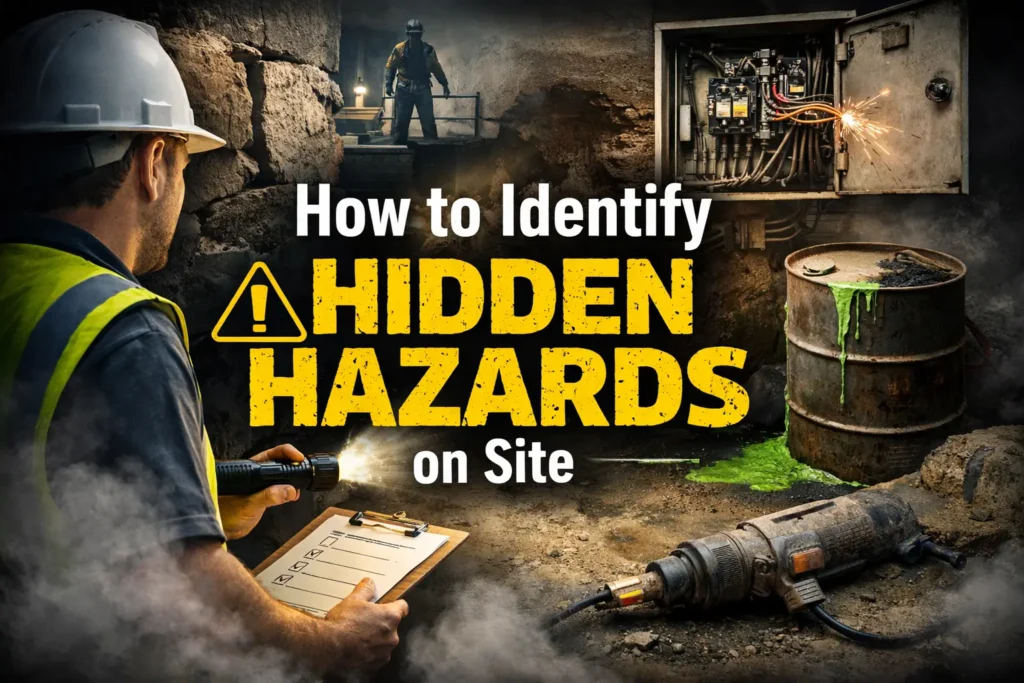
How to Identify Hidden Hazards on Site
Hidden hazards are risks that are not immediately visible during routine inspections. Unlike obvious dangers such as open edges or moving machinery, hidden hazards remain unnoticed until they cause an incident.
They can exist in systems, processes, behaviors, or even small unnoticed defects. These hazards are dangerous because they create a false sense of safety.
Why They Are Dangerous
Hidden hazards are responsible for many serious accidents. Because they are not easily detected, they often bypass safety controls.
By the time they are identified, it may already be too late.
Difference Between Visible and Hidden Hazards
Why Hidden Hazards Are Often Missed
Visible hazards are easy to identify. Hidden hazards require deeper analysis, observation, and questioning.
They are often missed because:
- Inspections are rushed
- Focus is only on obvious risks
- Lack of experience
- Overconfidence
Common Types of Hidden Hazards
Structural, Electrical, Chemical, Behavioral
Hidden hazards can exist in many forms:
- Structural issues such as weak supports
- Electrical faults inside panels
- Chemical exposure risks
- Unsafe worker behavior
Understanding these categories helps in identifying risks effectively.
Step-by-Step Process to Identify Hidden Hazards
Site Observation Techniques
Start with detailed observation. Do not just walk through the site. Stop, observe, and analyze.
Look for unusual conditions, patterns, and inconsistencies.
Asking the Right Questions
Ask yourself:
- What can go wrong here?
- What is missing?
- What if something fails?
These questions help uncover hidden risks.
Importance of Risk Assessment
HIRA and JSA Role
Risk assessment tools like HIRA (Hazard Identification and Risk Assessment) and JSA (Job Safety Analysis) are essential.
They help identify hazards that may not be visible during normal inspections.
Using Experience and Intuition
Learning from Past Incidents
Experience plays a major role. Past incidents and near misses provide valuable lessons.
Over time, you develop an instinct to identify risks.
Worker Interaction and Feedback
Ground-Level Insights
Workers are closest to the job. They often know risks that are not documented.
Talking to them can reveal hidden hazards.
Identifying Behavioral Hazards
Unsafe Acts
Behavioral hazards include:
- Ignoring PPE
- Taking shortcuts
- Unsafe practices
These are often hidden because they occur when supervision is low.
Checking Equipment and Tools
Hidden Defects
Equipment may look fine externally but have internal issues.
Regular inspection and testing are necessary.
Environmental and Site Conditions
Weather and Layout Risks
Environmental factors such as weather, lighting, and site layout can create hidden risks.
Reviewing Past Incidents and Near Misses
Early Warning Signs
Near misses are warning signs. Analyzing them helps identify hidden hazards before they cause accidents.
Common Mistakes While Identifying Hazards
Overconfidence and Routine Inspections
Routine inspections can lead to overconfidence. This reduces attention to detail.
Tools and Techniques for Hazard Identification
Checklists, Audits, Monitoring
Using tools such as:
- Checklists
- Safety audits
- Monitoring systems
can improve hazard identification.
Role of Safety Officers
Proactive Approach
Safety officers must be proactive. They should not wait for incidents to happen.
Real Example of Hidden Hazard
Lessons Learned
In one case, a hidden electrical fault caused a fire. The equipment looked normal, but internal wiring was damaged.
This shows the importance of detailed inspection.
How to Improve Hazard Identification Skills
Continuous Learning
Improvement comes from:
- Experience
- Training
- Learning from incidents
Key Takeaways
- Hidden hazards are not easily visible
- Observation and questioning are key
- Worker involvement is important
- Continuous monitoring is required
- Experience improves detection
Conclusion
Identifying hidden hazards is one of the most important skills for a safety professional. It requires attention, experience, and a proactive mindset. By improving your approach, you can prevent accidents and create a safer workplace.
The Biggest Mistake in Risk Assessment That Causes Accidents
Safety Risk Assessment for Lifting Operations (Complete Practical Guide)
Risk Assessment for Excavation Activities
Difference Between HIRA JSA and Risk Assessment
5 Levels of Risk Control (Hierarchy of Controls) Explained
FAQs
1. What are hidden hazards?
Risks that are not easily visible during inspections.
2. Why are hidden hazards dangerous?
Because they are often unnoticed until an accident occurs.
3. How to identify hidden hazards?
Through observation, questioning, and risk assessment.
4. What tools help in hazard identification?
HIRA, JSA, audits, and checklists.
5. Who is responsible for identifying hazards?
Safety officers, supervisors, and workers.
