 Skip to content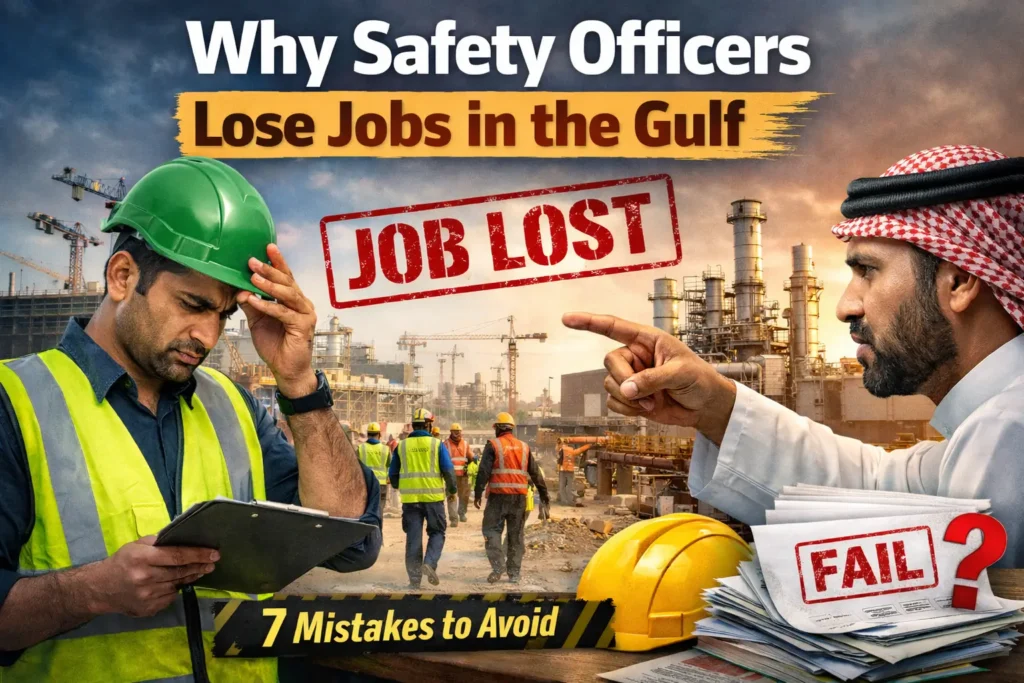
Why Safety Officers Lose Jobs in the Gulf, 7 Mistakes to Avoid
Every year, thousands of safety officers move to the Gulf with high hopes.
Good salary.
International exposure.
Career growth.
Yet many of them return home within months, jobless, confused, and frustrated.
This is not because the Gulf has no safety jobs.
It is because most safety officers repeat the same critical mistakes without even realizing it.
I have seen excellent resumes fail. I have seen experienced officers replaced quickly. And I have seen freshers lose jobs within probation.
This article explains the real reasons safety officers lose jobs in the Gulf and the 7 mistakes you must avoid if you want a stable career in UAE, Saudi Arabia, Qatar, or other Gulf countries.
Understanding the Gulf Safety Job Reality
Gulf countries follow strict compliance driven safety systems. Projects are deadline focused, audit heavy, and legally sensitive.
Employers expect safety officers to perform from day one.
There is very little tolerance for:
- confusion
- poor communication
- weak documentation
- excuse based safety
Certifications help you enter, but performance decides survival.
Mistake 1, Thinking Certification Alone Is Enough
This is the biggest reason safety officers lose jobs.
Many officers believe that NEBOSH or OSHA guarantees job security.
In reality, Gulf employers expect you to:
- conduct daily inspections independently
- prepare reports without guidance
- handle client audits confidently
- answer legal and site questions clearly
A certificate gets you shortlisted. Skills keep you employed.
Mistake 2, Poor Communication Skills
In the Gulf, safety officers communicate with:
- workers from multiple countries
- supervisors and engineers
- consultants and clients
If you cannot explain hazards clearly, you are seen as ineffective.
Common communication problems
- fear of speaking English
- unclear instructions during toolbox talks
- inability to explain observations
- poor email and report writing
Even technically strong officers lose jobs due to weak communication.
Mistake 3, Ignoring Documentation and Reports
In Gulf projects, if it is not documented, it did not happen.
Many officers focus only on site work and neglect paperwork.
Critical documents include
- daily safety reports
- inspection checklists
- incident reports
- near miss records
- training attendance sheets
Clients and auditors judge safety officers by documentation quality.
Poor reports equal poor performance in management eyes.
Mistake 4, Acting Like a Police Officer
Some safety officers believe shouting, stopping work, or threatening workers shows authority.
This approach backfires badly in the Gulf.
Why this fails
- workers complain to supervisors
- supervisors complain to management
- management sees you as a problem
Effective safety officers influence, not intimidate.
The Gulf values coordination, respect, and practical problem solving.
Mistake 5, Lack of Local Regulation Awareness
Each Gulf country has its own laws and standards.
For example:
- UAE follows local OSHAD and municipality rules
- Saudi Arabia follows SBC and local labor laws
- Qatar follows QCS standards
Many officers rely only on NEBOSH or OSHA knowledge and ignore local regulations.
This creates legal risk for companies.
Employers replace officers who cannot answer regulation related questions.
Mistake 6, No Understanding of Client Expectations
In the Gulf, the client often has more power than the contractor.
Safety officers must understand:
- client safety policies
- reporting formats
- audit expectations
- permit systems
If a client is unhappy, the company reacts fast.
Many officers lose jobs not due to mistakes, but due to client dissatisfaction.
Mistake 7, Overconfidence or Zero Initiative
Two dangerous extremes.
Overconfidence
Some officers argue with engineers, reject instructions, or act superior.
Zero initiative
Some officers only act when told and never suggest improvements.
Gulf employers want balanced professionals who:
- follow instructions
- suggest improvements
- take responsibility
- support project goals
Lack of adaptability leads to replacement.
Why Replacement Happens So Fast in the Gulf
The Gulf job market is competitive.
There are always:
- experienced candidates available
- local transfers
- cheaper replacements
Companies do not wait long to decide.
Probation periods are real evaluations.
How to Protect Your Job in the Gulf
Build practical skills
Inspection, reporting, audits, and communication matter more than theory.
Learn local rules
Spend time understanding country specific safety regulations.
Improve reporting
Clear, professional reports create strong impressions.
Work with teams
Support supervisors instead of fighting them.
Stay updated
Follow safety updates from bodies like International Labour Organization, whose guidance influences Gulf safety practices.
Many Gulf countries align their workplace safety expectations with international labour standards. Guidance published by the International Labour Organization (ILO) highlights the importance of competent safety supervision, proper documentation, worker communication, and management involvement. Employers in the Gulf increasingly expect safety officers to follow these globally accepted practices, not just hold certifications. Understanding and applying such international safety principles helps officers meet client expectations and avoid common job related risks.
Ideal Safety Officer Profile for the Gulf
Employers prefer officers who:
- combine NEBOSH or OSHA with experience
- communicate confidently
- document everything
- understand site operations
- respect cultural differences
This profile survives and grows.
Final Thoughts
Safety officers do not lose jobs in the Gulf because the market is bad.
They lose jobs because:
- expectations are misunderstood
- performance gaps are ignored
- mistakes repeat
If you avoid these 7 mistakes, your Gulf safety career can be stable, respected, and financially rewarding.
The Gulf does not want perfect safety officers.
It wants practical, responsible, and adaptable professionals.
Top 10 Countries Hiring Safety Officers Right Now (With Salary Data)
Best Country for Safety Officer Job in 2026
FAQs
Do safety officers get terminated easily in the Gulf
Yes, if performance is weak during probation.
Is NEBOSH mandatory for Gulf jobs
For most roles, yes, especially in construction and oil and gas.
Can freshers survive in the Gulf
Yes, if they learn fast and adapt quickly.
Is documentation really that important
Yes, documentation protects both the company and the safety officer.
What is the biggest survival skill
Clear communication combined with practical site knowledge.

This is very insightful. I’ve been following your blog and it’s been a huge boost to my safety career.
Happy for you!