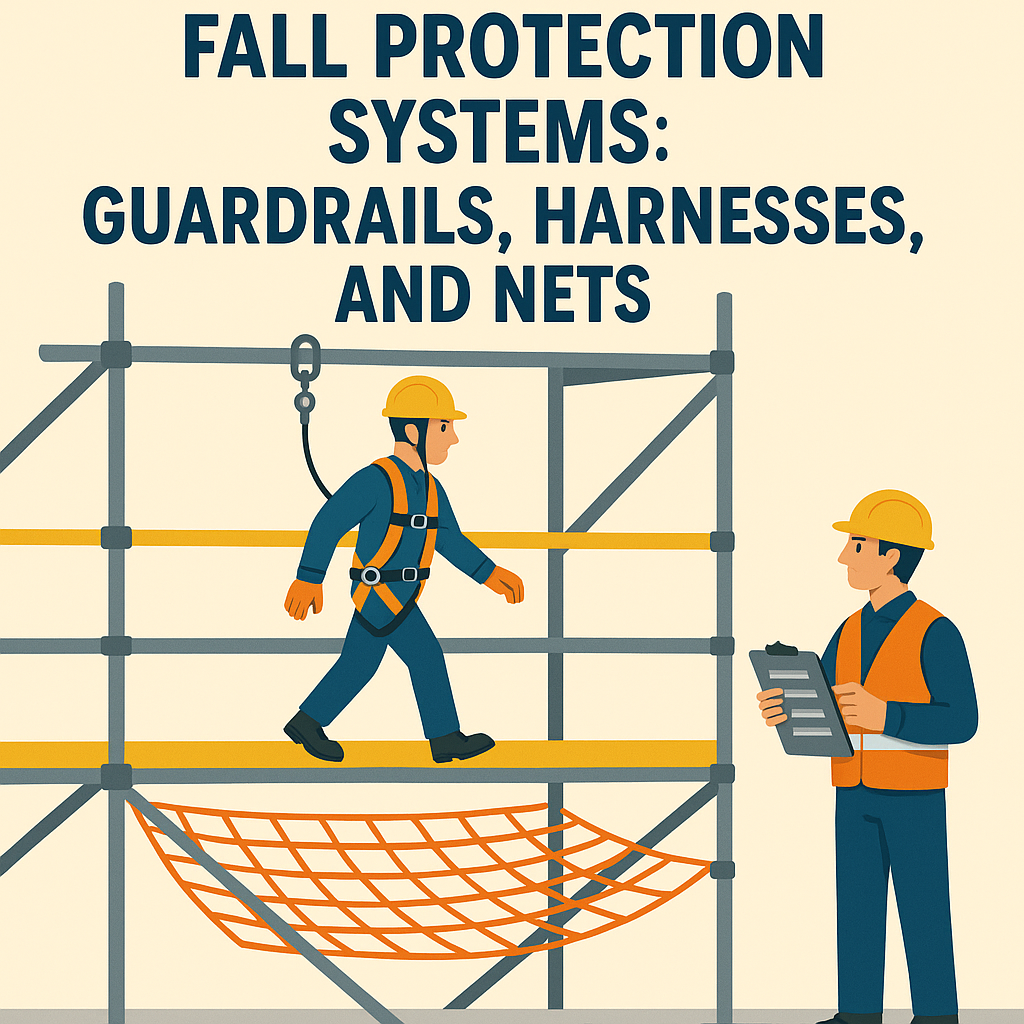
Fall Protection Systems: Guardrails, Harnesses, and Nets
Fall protection is one of the most critical safety requirements on construction sites, industrial facilities, and maintenance operations. A momentary slip or misstep can lead to a severe fall, resulting in life-altering injuries or fatalities. To prevent such incidents, organizations rely on engineered Fall Protection Systems, which are designed to either prevent a fall from happening or minimize harm if a fall occurs.
Among the most widely used systems are guardrails, safety harnesses, and safety nets. Each serves a distinct purpose and must be selected and applied correctly depending on work conditions, height, and risk level.
This article breaks down how these systems work, where they should be used, and the best practices for ensuring fall protection excellence.
Understanding Fall Protection Systems
Fall protection systems include equipment and methods that reduce the risk of falling from heights. They serve to either:
- Prevent a fall entirely,
- Restrain a worker from reaching a fall hazard, or
- Arrest a fall after it begins, minimizing injury.
Fall protection requirements vary depending on industry standards, but most regulations mandate protection for workers exposed to fall hazards at 1.8 meters (6 ft) or higher.
The Hierarchy of Fall Protection
Fall protection should always follow the hierarchy of controls.
Eliminate Work at Height
Work from the ground whenever possible using tools or equipment extensions.
Use Collective Protection
Guardrails and barriers protect all workers in the area.
Use Personal Fall Protection (PFAS)
Harnesses, lanyards, and lifelines protect individual workers.
Use Safety Nets
Catch workers or debris where PPE or guardrails may not be feasible.
Administrative Controls
Training, permit systems, supervision, and work procedures.
Personal Protective Equipment
The final layer of protection.
Guardrails as a Fall Prevention System
Guardrails are physical barriers installed along elevated edges to prevent workers from falling. They are considered collective fall protection, requiring no special training or equipment for workers to be protected.
Components of Guardrail Systems
Top Rail
Positioned at approximately 42 inches (1.1 m), it prevents workers from toppling over.
Mid Rail
Placed halfway between the top rail and the working surface to prevent slipping below the top rail.
Toe Board
A vertical barrier preventing tools and materials from falling onto workers below.
Support Posts
Provide structural integrity to the system.
Where Guardrails Are Used
Guardrails are common on:
- Scaffolds
- Rooftop edges
- Walkways and ramps
- Open floor edges
- Parapets
- Elevated platforms
They are the safest and preferred method for fall prevention.
Guardrail Best Practices
- Must withstand 200 lbs (890 N) of force.
- Install toe boards where falling objects pose a risk.
- Ensure rails are smooth, without sharp edges.
- Conduct daily inspections.
- Install only by competent personnel.
- Keep materials and debris away from edges.
Harnesses as Part of Personal Fall Arrest Systems (PFAS)
Safety harnesses protect workers by stopping a fall that has already begun. They are essential when fall prevention is not feasible.
Components of Full-Body Harnesses
Dorsal D-Ring
Main attachment point located on the upper back.
Shoulder and Chest Straps
Keep the harness secure and distribute energy during a fall.
Leg Straps
Must be properly tightened to support body weight.
Sub-Pelvic Strap
Supports the lower body during suspension after a fall.
Buckles and Adjusters
Used for fit and comfort.
Types of Harness Applications
- Fall Arrest Harnesses for general height work.
- Work Positioning Harnesses to allow hands-free work.
- Climbing/Rope Access Harnesses with multiple attachment points.
- Confined Space Harnesses for vertical entry and rescue.
Using Harness Systems Safely
Inspection Before Use
Check straps, stitching, buckles, and D-ring integrity.
Proper Fit
Harness must be snug but comfortable.
Compatible Lanyards or SRLs
Use shock-absorbing lanyards for fall arrest and SRLs for vertical mobility.
Anchor Point Requirements
Anchors must support at least 5,000 lbs (22 kN) per worker.
Fall Arrest vs Fall Restraint
Fall Arrest
Allows mobility near edges but stops a fall after it begins.
Fall Restraint
Prevents workers from reaching hazardous edges.
Safer and preferred when possible.
Common Harness Safety Mistakes
- Loose or improperly fitted harness
- Using expired equipment
- Connecting to inadequate anchors
- Tying knots in lanyards
- Working without a rescue plan
A fall arrest system is never complete without rescue procedures.
Safety Nets as Collective Fall Protection
Safety nets catch falling workers or debris. They are typically used in large open sites, such as:
- Bridges
- High-rise building frames
- Industrial maintenance shutdowns
- Structural steel erection
Types of Safety Nets
Personnel Nets
Designed to catch workers who fall.
Debris Nets
Prevent tools and materials from falling.
Combination Nets
Protect workers and capture debris simultaneously.
Safety Net Installation Requirements
- Install as close as possible beneath work levels.
- Must be strong enough to absorb fall impact.
- Anchor to approved structural points.
- Inspect weekly or after any fall event.
- Must be free from damage, tears, or frayed mesh.
Advantages of Safety Nets
- Protect multiple workers simultaneously.
- Allow more movement freedom.
- Ideal where fall arrest PPE is less effective.
- Reduce injury severity.
Limitations of Safety Nets
- Installation complexity
- Ongoing inspections required
- Not suitable for tight or enclosed areas
Comparison: Guardrails vs Harnesses vs Safety Nets
| System | Primary Purpose | Best Environment | Key Advantage |
|---|---|---|---|
| Guardrails | Prevent falls | Scaffolds, roofs, edges | No PPE needed |
| Harnesses | Arrest falls | High-risk or mobile tasks | Maximum mobility |
| Safety Nets | Catch falls | Bridges, high-rise frames | Protect many workers |
Each system has its strengths — selection depends on your risk assessment.
Best Practices for Fall Protection
Plan Work in Advance
Conduct risk assessment, choose the correct equipment, and inspect site conditions.
Use the Safest Option First
Collective protection (guardrails) is preferable to personal devices.
Inspect Equipment Regularly
Remove damaged harnesses, lanyards, and nets from service.
Train Workers Thoroughly
Ensure all personnel understand fall hazards and equipment use.
Implement a Rescue Plan
Workers cannot remain suspended in a harness for long — rapid rescue is essential.
Monitor Weather Conditions
Wind, rain, or ice can significantly increase fall risk.
Conclusion
Fall protection is a vital part of safe work at height. Guardrails prevent falls, harnesses arrest falls, and safety nets provide additional protection where other systems may not be sufficient. A combination of these systems, supported by worker training, inspections, and rescue planning, ensures the highest level of safety.
By selecting the right fall protection system and implementing it correctly, organizations can drastically reduce fall-related incidents and create a safer workplace.
For checklist and templates visit The HSE Tools.
Safe Work at Height Procedures and Best Practices
Fall Protection Measures at Construction Sites
Top 10 Safety Rules for Construction Workers
10 Must-Know Working at Height Safety Training Rules
Slip, Trip, and Fall Prevention Strategies
FAQs
1. Which fall protection system is the safest?
Guardrails, because they prevent falls without requiring PPE or worker action.
2. When should a harness be used?
When guardrails are not possible, such as during tower climbing, roofing, or MEWP use.
3. How often should safety nets be inspected?
Weekly and after any fall or impact.
4. Who can install fall protection systems?
Only trained and competent persons.
5. Do all fall arrest systems require a rescue plan?
Yes — a rescue plan is mandatory whenever a harness is used.
