 Skip to content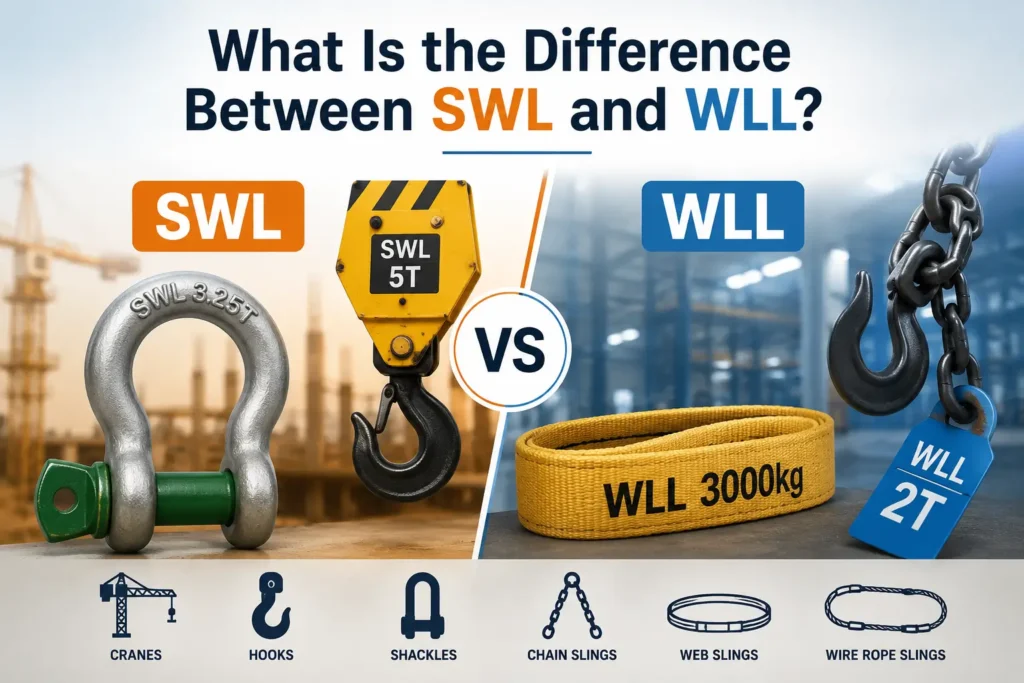
What Is the Difference Between SWL and WLL?
Lifting operations are a routine part of construction, oil and gas, manufacturing, shipping, and industrial projects.
Every day, workers use:
- cranes
- chain slings
- wire rope slings
- shackles
- hooks
- lifting beams
to move heavy loads safely.
Before any lift begins, one of the most important things to verify is the lifting equipment’s capacity.
This often leads to a common question asked during HSE interviews, lifting training, and toolbox talks:
What Is the Difference Between SWL and WLL?
Many people believe these two terms mean exactly the same thing.
While they are closely related, there is an important difference.
SWL (Safe Working Load)
is an older engineering term used to describe the maximum load that equipment can safely handle during normal operations.
WLL (Working Load Limit)
is the modern term used by manufacturers and international lifting standards to indicate the maximum load that lifting equipment is designed to carry safely.
Today, most manufacturers and international standards recommend using:
WLL (Working Load Limit)
instead of SWL.
Let’s understand why this change occurred and why it matters.
What Does SWL Mean?
SWL stands for:
Safe Working Load
Traditionally, SWL referred to:
The maximum load that lifting equipment could safely lift under normal working conditions.
SWL was commonly marked on:
- cranes
- hooks
- shackles
- lifting slings
- chain blocks
For many years, SWL was the standard terminology used throughout the lifting industry.
Even today, many experienced workers continue using the term.
What Does WLL Mean?
WLL stands for:
Working Load Limit
It represents:
The maximum load that lifting equipment is designed to carry safely during normal operation.
Modern manufacturers use WLL because it provides a clearer engineering definition.
WLL is now commonly displayed on:
- synthetic slings
- chain slings
- wire rope slings
- shackles
- lifting accessories
Most international lifting standards now refer to WLL instead of SWL.
Why Was SWL Replaced by WLL?
Over time, engineers recognized that the term:
Safe Working Load
could be misunderstood.
Some people believed it represented an absolute guarantee of safety.
In reality, lifting safety depends on many factors besides equipment capacity.
These include:
- sling angles
- equipment condition
- load balance
- weather
- lifting method
Because of this, international standards gradually adopted:
Working Load Limit (WLL)
which more accurately describes the equipment’s rated capacity.
Is SWL the Same as WLL?
In many workplaces, the two terms are used interchangeably.
However, technically:
SWL
Older industry terminology.
WLL
Current internationally accepted terminology.
In practical lifting operations, both generally refer to:
The maximum allowable working load of lifting equipment.
The important point is that neither value should ever be exceeded.
Why WLL Is More Accurate
Working Load Limit emphasizes that:
- equipment has operating limits
- lifting conditions matter
- proper use is essential
Even equipment with a high WLL can fail if:
- overloaded
- damaged
- improperly rigged
- used incorrectly
Safe lifting depends on more than simply reading the label.
Where Can You Find the WLL?
Manufacturers usually mark the WLL on:
- sling identification tags
- hooks
- shackles
- lifting clamps
- chain assemblies
The marking typically includes:
- capacity
- serial number
- manufacturer
- inspection information
If the identification tag is missing or unreadable, the equipment should not be used until its capacity is confirmed.
Why Should WLL Never Be Exceeded?
Exceeding the Working Load Limit creates serious hazards.
Possible consequences include:
Sling Failure
The lifting sling may snap.
Hook Deformation
The hook may permanently bend.
Shackle Failure
Connection points may break.
Dropped Load
The load may fall without warning.
These failures can result in:
- serious injuries
- fatalities
- equipment damage
- costly project delays
What Factors Affect Safe Lifting?
Knowing the WLL is only the beginning.
Safe lifting also depends on:
Sling Angle
Smaller sling angles increase tension.
Load Distribution
Uneven loads create additional stress.
Dynamic Loading
Sudden movements increase forces.
Equipment Condition
Damaged lifting gear has reduced strength.
These factors must always be considered before lifting.
What Is the Safety Factor?
Lifting equipment is manufactured with a:
Safety Factor
This means the equipment is tested well beyond its rated working capacity.
For example:
A lifting sling with a WLL of:
2 Tons
may have an actual breaking strength several times higher.
However:
Workers must never rely on the safety factor by intentionally exceeding the WLL.
The safety factor exists to provide additional protection against unexpected loading conditions.
Common Equipment That Displays WLL
Many lifting accessories include their Working Load Limit.
Examples include:
- chain slings
- web slings
- round slings
- hooks
- shackles
- eye bolts
- lifting beams
Before every lift, workers should confirm that every component has adequate capacity.
The weakest component determines the maximum safe load.
Common Mistakes During Lifting Operations
Safety Officers frequently observe:
Ignoring Equipment Labels
Workers assume capacity without checking.
Using Damaged Slings
Wear reduces lifting strength.
Exceeding WLL
Loads are underestimated.
Mixing Incompatible Equipment
Different capacities create weak points.
These mistakes contribute to many lifting accidents.
Why Safety Officers Check WLL Before Every Lift
During lifting inspections, Safety Officers verify:
- load weight
- equipment capacity
- inspection status
- certification
- sling angles
- lifting method
Confirming the Working Load Limit is one of the first steps in every safe lifting operation.
Proper planning prevents equipment failure.
Why This Question Appears in Safety Interviews
Interviewers often ask:
“What is the difference between SWL and WLL?”
A strong answer is:
SWL is the older term for Safe Working Load, while WLL is the modern internationally accepted term for Working Load Limit.
Candidates should also explain:
- why WLL replaced SWL
- equipment labeling
- lifting safety
- overloading risks
This demonstrates practical lifting knowledge.
Why Understanding WLL Improves Workplace Safety
Many lifting accidents occur because workers:
- guess equipment capacity
- ignore identification tags
- overload lifting gear
Understanding WLL helps workers make informed decisions before lifting begins.
It encourages proper equipment selection and reduces the likelihood of equipment failure.
Knowledge is one of the strongest safety controls.
Conclusion
The difference between SWL and WLL is mainly one of terminology.
SWL (Safe Working Load)
is the traditional term that was widely used in the past.
WLL (Working Load Limit)
is the modern term now used by manufacturers and international lifting standards.
Although both generally describe the maximum safe operating load, WLL is considered more accurate and is the preferred terminology today.
Regardless of the term used, lifting equipment should never be loaded beyond its rated capacity.
Following WLL markings, inspecting lifting equipment, and planning every lift carefully are essential steps in preventing lifting accidents and protecting workers.
What Is the Safe Working Load of a Chain Block?
What Is the Maximum Wind Speed Allowed for Tower Crane Operations?
FAQs
What does SWL stand for?
SWL stands for Safe Working Load.
What does WLL stand for?
WLL stands for Working Load Limit.
Which term is used today?
Most manufacturers and international standards now use WLL instead of SWL.
Can SWL and WLL be used interchangeably?
In many workplaces they are used interchangeably, but WLL is the preferred modern terminology.
Why should lifting equipment never exceed its WLL?
Exceeding the Working Load Limit can cause equipment failure, dropped loads, serious injuries, and fatalities.
