 Skip to content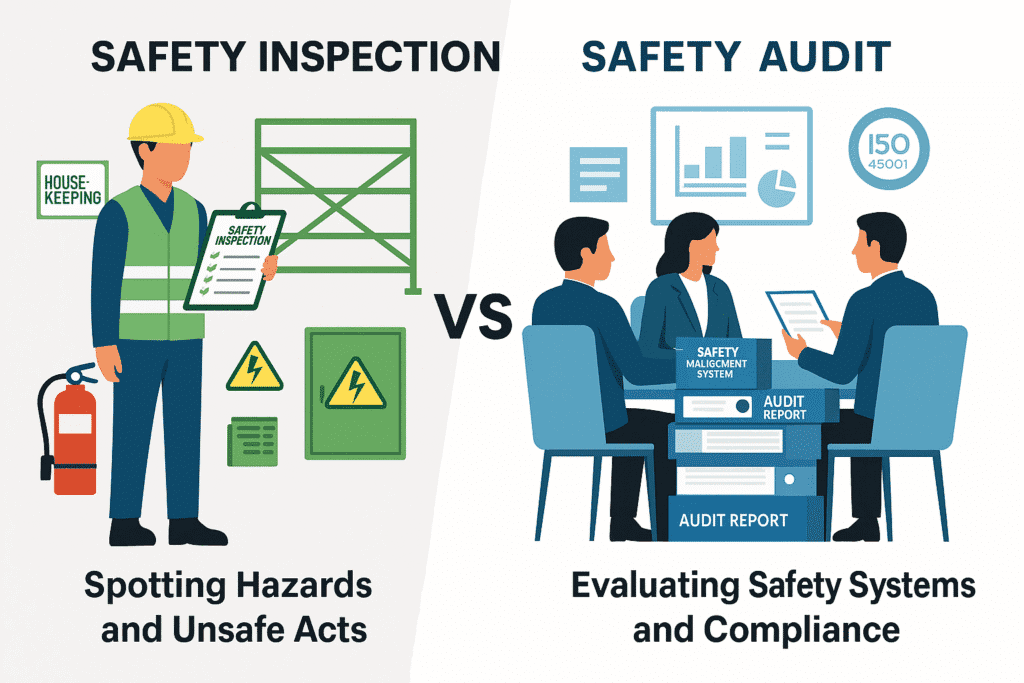
Safety Inspection vs Safety Audit: Understanding the Difference for a Safer Workplace
Many organizations use the terms safety inspection and safety audit interchangeably — but they are not the same.
Both are vital parts of a strong health and safety management system, yet their goals, scope, frequency, and approach differ significantly.
In simple words:
- A safety inspection checks what is wrong right now.
- A safety audit checks why things go wrong and how the system can improve.
This article explains their definitions, key differences, procedures, and how both complement each other in creating a proactive safety culture.
What is a Safety Inspection?
Definition
A Safety Inspection is a routine examination of the workplace to identify hazards, unsafe conditions, or unsafe acts that could cause accidents or injuries.
It focuses on the physical environment — checking compliance with safety standards, procedures, and housekeeping.
Purpose
- Detect unsafe acts and conditions.
- Ensure compliance with safety rules.
- Identify immediate hazards before they cause harm.
- Verify availability and condition of safety equipment.
- Maintain a safe working environment.
Frequency
Safety inspections are conducted frequently — daily, weekly, or monthly — depending on the workplace type and risk level.
Who Conducts It?
- Safety Officers
- Supervisors
- Line Managers
- Trained Safety Representatives
Examples
- Checking fire extinguishers for pressure and accessibility.
- Ensuring electrical cords are undamaged.
- Inspecting scaffolds, ladders, or PPE.
- Verifying machine guards and housekeeping.
- Identifying spillages or trip hazards.
Example: During a site walkthrough, the safety officer notices blocked emergency exits — an unsafe condition that requires immediate action.
What is a Safety Audit?
Definition
A Safety Audit is a systematic and comprehensive review of an organization’s overall safety management system (SMS).
It evaluates policies, procedures, and practices to ensure they are effective, compliant, and continually improving.
Purpose
- Assess the effectiveness of the safety management system.
- Evaluate compliance with legal and ISO standards.
- Identify gaps between policy and implementation.
- Recommend improvements for long-term safety performance.
- Verify leadership commitment and employee involvement.
Frequency
Safety audits are conducted less frequently — usually annually or bi-annually — but in much greater detail.
Who Conducts It?
- Internal or external auditors.
- Third-party consultants or certification bodies (for ISO 45001).
- Corporate safety teams during system reviews.
Examples
- Reviewing the Permit to Work (PTW) system for effectiveness.
- Checking if training records match actual competencies.
- Verifying that incident investigations are completed and closed.
- Examining compliance with ISO 45001 clauses or OSHA requirements.
Example: An external audit finds that risk assessments are outdated and recommends revising the process for better hazard identification.
Key Differences Between Safety Inspection and Safety Audit
| Aspect | Safety Inspection | Safety Audit |
|---|---|---|
| Definition | Routine check of workplace conditions and practices | Systematic evaluation of the entire safety management system |
| Purpose | Identify hazards and ensure compliance | Assess effectiveness of policies and procedures |
| Focus Area | Physical conditions, equipment, and acts | Systems, documentation, and management performance |
| Frequency | Regular (daily, weekly, monthly) | Periodic (annual, bi-annual) |
| Conducted By | Supervisors, safety officers | Internal or external auditors |
| Nature | Operational and preventive | Strategic and evaluative |
| Outcome | Corrective action for specific issues | Recommendations for system improvement |
| Documentation | Inspection checklist | Comprehensive audit report |
| Example | Checking fire extinguisher condition | Reviewing the fire safety management program |
Relationship Between Inspection and Audit
Although different in purpose, safety inspections and safety audits are interdependent:
- Inspections identify immediate hazards and ensure day-to-day safety.
- Audits evaluate the system’s ability to manage those hazards in the long run.
In other words:
“Inspections keep workers safe today; audits keep the organization safe tomorrow.”
Example:
- Inspection finds a missing guard on a machine → fixed immediately.
- Audit reviews why guards are often missing → identifies a failure in maintenance policy.
Safety Inspection Process
- Planning: Define inspection area, frequency, and responsible persons.
- Preparation: Review previous reports and checklist.
- Execution: Conduct site walkthrough and record observations.
- Reporting: Classify hazards (critical, major, minor).
- Action: Recommend corrective and preventive actions.
- Follow-up: Verify closure and improvement.
Sample Inspection Checklist
| Item | Observation | Action Required |
|---|---|---|
| Fire extinguisher charged and accessible? | Yes | – |
| PPE being worn by workers? | No | Toolbox talk and reissue PPE |
| Electrical cords undamaged? | Yes | – |
Safety Audit Process
- Scope Definition: Identify departments, activities, and documents to be reviewed.
- Pre-Audit Meeting: Explain objectives to management.
- Document Review: Check policies, risk assessments, training records, and permits.
- Field Verification: Observe workplace implementation.
- Interviews: Engage with employees and supervisors.
- Findings and Recommendations: Identify non-conformities and suggest improvements.
- Closing Meeting: Present findings and agree on corrective actions.
- Audit Report: Document results for management review.
Types of Safety Audits
| Type | Purpose |
|---|---|
| Internal Audit | Conducted by the organization to assess compliance and performance. |
| External Audit | Conducted by a third-party or certification body for compliance validation. |
| Compliance Audit | Focused on legal and regulatory standards (OSHA, ISO 45001). |
| Management System Audit | Evaluates the overall safety management structure. |
| Behavioral Audit | Focuses on employee behavior and leadership engagement. |
Benefits of Safety Inspections
- Immediate identification of unsafe acts or conditions.
- Reduces incident potential through early detection.
- Improves employee awareness and accountability.
- Enhances workplace housekeeping.
- Builds a proactive safety culture.
Benefits of Safety Audits
- Identifies systemic weaknesses in safety management.
- Improves long-term compliance and effectiveness.
- Demonstrates due diligence and legal compliance.
- Enhances leadership accountability.
- Provides strategic insights for continuous improvement.
Example Scenario: Construction Site
| Safety Inspection | Safety Audit |
|---|---|
| Inspects scaffolds, ladders, and PPE daily. | Reviews scaffolding policy and inspection frequency. |
| Ensures housekeeping and fire extinguishers are maintained. | Evaluates compliance with site safety plan and training effectiveness. |
| Focuses on immediate hazards. | Focuses on safety system performance and improvement. |
Integration in a Safety Management System
Both inspection and audit are essential components of a Safety Management System (SMS) as per ISO 45001:2018.
| ISO 45001 Clause | Activity |
|---|---|
| 8.1 – Operational Control | Safety Inspections |
| 9.2 – Internal Audit | Safety Audits |
| 10.2 – Nonconformity and Corrective Action | Outcomes of both inspections and audits |
Together, they help maintain compliance, improve efficiency, and ensure ongoing safety performance.
Common Mistakes Organizations Make
- Treating audits and inspections as one and the same.
- Conducting inspections without follow-up actions.
- Failing to close audit findings.
- Not analyzing trends or recurring hazards.
- Lack of worker involvement or feedback.
Summary Table: Safety Inspection vs Safety Audit
| Category | Safety Inspection | Safety Audit |
|---|---|---|
| Goal | Identify unsafe conditions | Evaluate management system effectiveness |
| Focus | Equipment, environment, behavior | Policies, procedures, compliance |
| Frequency | Frequent (daily to monthly) | Periodic (annual to bi-annual) |
| Conducted By | Supervisors/Safety Officers | Internal/External Auditors |
| Output | Hazard list and corrective actions | Audit report and improvement plan |
| Example | Inspecting fire extinguishers | Evaluating fire safety program |
| Approach | Operational | Strategic |
Conclusion
In conclusion, while Safety Inspections and Safety Audits serve different purposes, both are critical to building a world-class safety culture.
- Inspections keep workplaces safe in the short term by identifying immediate risks.
- Audits ensure long-term sustainability by strengthening safety systems and management practices.
“Inspections correct what’s visible today — audits prevent what’s invisible tomorrow.”
A balanced approach using both tools ensures continuous improvement, compliance, and most importantly — the safety of every worker.
For checklist and templates visit The HSE Tools.
Safety Policy vs Safety Manual
Construction Safety Checklist Generator – Complete Guide for Safety Professionals
Training Attendance Sheet Generator – Complete Guide for Safety Professionals
Safety Induction Checklist Generator – Complete Guide for Safety Professionals
Toolbox Talk Generator – Complete Guide for Safety Professionals
FAQs
Q1. What comes first — inspection or audit?
Safety inspections are conducted regularly and feed into audits, which analyze inspection trends and system performance.
Q2. Who should conduct safety audits?
Trained internal auditors or external experts certified in ISO 45001 or OHSMS auditing.
Q3. How often should inspections and audits be conducted?
Inspections: daily/weekly/monthly based on risk.
Audits: annually or bi-annually.
Q4. Can an audit replace inspections?
No. Audits assess the system; inspections monitor the workplace conditions.
Q5. What should an organization do after an audit or inspection?
Implement corrective actions, monitor effectiveness, and ensure continuous improvement.
