 Skip to content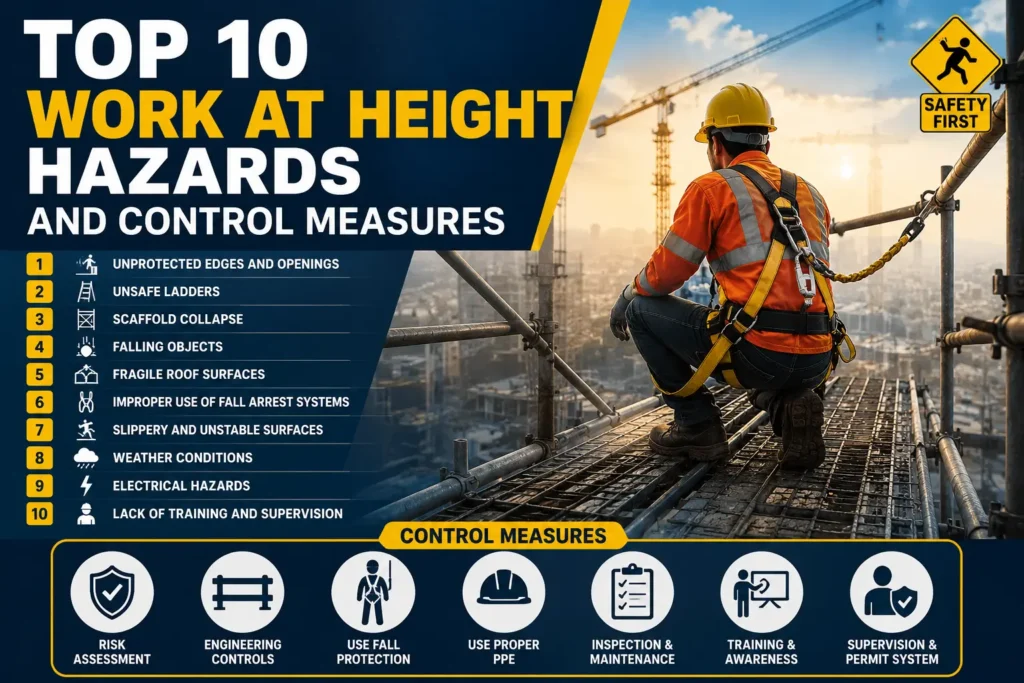
Top 10 Work at Height Hazards and Control Measures
Working at height is one of the most dangerous activities in construction, maintenance, oil and gas, warehousing, and industrial operations. A single mistake while working above ground level can lead to serious injuries, permanent disabilities, or fatalities. Whether workers are standing on scaffolding, climbing ladders, operating boom lifts, or working on rooftops, the risks are always present.
According to recent workplace safety reports, falls from height continue to be the leading cause of fatalities in the construction industry worldwide. Recent OSHA statistics show that falls account for more than one-third of construction related deaths every year. These numbers highlight why organizations must focus heavily on identifying hazards and implementing strong control measures before any elevated work begins.
Many workers believe accidents only happen during complex jobs. The reality is different. Even routine activities like climbing a ladder, stepping onto a platform, or walking near an open edge can become deadly within seconds. That is why understanding work at height hazards and control measures is essential for every worker, supervisor, and safety professional.
Understanding Work at Height
Work at height refers to any activity where a person could fall and injure themselves if proper precautions are not in place. This includes working on ladders, scaffolding, roofs, elevated platforms, towers, excavations, or near floor openings. Many people assume work at height only applies to extremely high locations, but even a fall from a short distance can cause serious injuries.
Imagine walking on a narrow ledge while carrying heavy tools. One small slip, a sudden distraction, or unstable footing can instantly change the situation from normal to life-threatening. That is exactly why working at height requires detailed planning and strict safety procedures.
What Is Considered Work at Height?
Any work where a worker can fall from one level to another is generally considered work at height. This includes construction activities, maintenance tasks, painting work, steel erection, window cleaning, roofing, and even warehouse operations involving elevated storage systems.
Work at height also includes situations where workers may fall into openings, shafts, pits, or fragile surfaces. Safety professionals must evaluate every elevated work area carefully before authorizing work to begin.
Why Height Work Is Extremely Dangerous
Gravity never gives second chances. When workers fall from height, the impact force on the body increases dramatically depending on the height and fall distance. Injuries may include fractures, spinal damage, traumatic brain injuries, or fatalities.
Another danger is that height work often combines multiple hazards at the same time. Workers may face electrical risks, unstable surfaces, poor weather conditions, and moving equipment simultaneously. This combination increases the likelihood of severe accidents.
The fast-paced nature of construction work can also create pressure to complete tasks quickly. Workers sometimes take shortcuts by ignoring harnesses, climbing improperly, or bypassing safety barriers. These shortcuts often become the root cause of serious incidents.
Importance of Hazard Identification Before Working at Height
Hazard identification is the foundation of safe height work. Before workers step onto any elevated area, employers must identify possible risks and implement proper control measures. A strong risk assessment acts like a roadmap that guides workers safely through dangerous tasks.
Without hazard identification, workers may unknowingly expose themselves to hidden dangers such as weak surfaces, unstable scaffolds, or electrical lines.
Legal Responsibilities and Safety Compliance
Most workplace safety regulations require employers to protect workers from fall hazards. Organizations such as Occupational Safety and Health Administration enforce strict rules regarding fall protection, scaffolding, ladders, and training requirements.
Employers who fail to implement proper controls may face penalties, project shutdowns, lawsuits, and reputational damage. More importantly, they place workers’ lives at risk.
Role of Risk Assessments
Risk assessments help identify hazards before work begins. Supervisors examine the work area, evaluate environmental conditions, inspect equipment, and determine suitable control measures.
A proper risk assessment should answer critical questions:
- What hazards are present?
- Who may be affected?
- How severe could the consequences be?
- What control measures are required?
- What emergency procedures are necessary?
These assessments reduce uncertainty and improve decision-making on site.
Top 10 Work at Height Hazards and Control Measures
1. Unprotected Edges and Openings
One of the most common causes of falls is working near unprotected edges, floor openings, or roof perimeters. Workers may accidentally step backward, lose balance, or trip while carrying materials.
This hazard becomes even more dangerous in busy construction environments where workers are distracted by equipment noise, communication issues, or moving machinery.
Control Measures
- Install guardrails and toe boards around open edges.
- Use safety nets where guardrails are not possible.
- Cover floor openings securely and label them clearly.
- Ensure workers wear full-body harnesses connected to approved anchor points.
- Restrict access to hazardous areas.
2. Unsafe Ladders
Ladders are simple tools, yet they contribute to thousands of workplace injuries every year. Workers often misuse ladders by standing on the top rung, overreaching sideways, or using damaged ladders.
Many accidents happen because workers treat ladders like permanent work platforms instead of temporary access equipment.
Control Measures
- Inspect ladders before every use.
- Maintain the correct ladder angle ratio of 4:1.
- Use ladders on stable surfaces only.
- Ensure three-point contact while climbing.
- Never exceed the ladder’s load capacity.
- Replace damaged ladders immediately.
3. Scaffold Collapse
Scaffolding provides temporary elevated working platforms, but poorly erected or overloaded scaffolds can collapse without warning. Workers may fall while others below can be struck by falling materials.
Scaffold collapses often result from poor assembly, missing braces, weak foundations, or unauthorized modifications.
Control Measures
| Hazard | Control Measure |
|---|---|
| Weak foundation | Ensure stable and level ground |
| Overloading | Follow scaffold load limits |
| Poor assembly | Use trained scaffold erectors |
| Missing inspections | Conduct daily inspections |
| Missing guardrails | Install complete edge protection |
Regular inspections by competent persons are essential for scaffold safety.
4. Falling Objects
Tools, materials, and equipment falling from height can seriously injure workers below. A small wrench dropped from several floors can become deadly due to gravitational force.
Falling object hazards increase when workers fail to secure tools or when materials are stored improperly near edges.
Control Measures
- Install toe boards and debris nets.
- Use tool lanyards for hand tools.
- Secure loose materials properly.
- Establish exclusion zones below elevated work areas.
- Require workers below to wear safety helmets.
Good housekeeping also plays a major role in preventing dropped objects.
5. Fragile Roof Surfaces
Fragile roofs are extremely dangerous because workers may not realize the surface cannot support their weight. Materials such as asbestos cement sheets, skylights, fiberglass panels, and corroded roofing can collapse suddenly.
Many fatalities occur because workers assume the roof structure is safe without inspection.
Control Measures
- Conduct roof inspections before access.
- Use crawl boards or temporary platforms.
- Install warning signs around fragile areas.
- Use fall arrest systems.
- Restrict unauthorized roof access.
Workers should never step directly onto fragile surfaces.
6. Improper Use of Fall Arrest Systems
Fall arrest systems save lives only when used correctly. Incorrect harness fitting, improper anchor points, or damaged lanyards can make the entire system ineffective.
Some workers wear harnesses incorrectly because they lack proper training or find the equipment uncomfortable.
Control Measures
- Train workers on harness inspection and usage.
- Use certified anchor points only.
- Inspect lanyards and connectors before use.
- Replace damaged equipment immediately.
- Ensure proper harness fitting for each worker.
Fall protection equipment should never be treated casually.
7. Slippery and Unstable Surfaces
Wet surfaces, oil spills, loose debris, mud, and uneven platforms create serious slip hazards during elevated work. Losing balance at height often leads to catastrophic falls.
Even experienced workers can lose footing when surfaces become unstable unexpectedly.
Control Measures
- Maintain clean work areas.
- Remove spills immediately.
- Use anti-slip footwear.
- Secure working platforms properly.
- Avoid working on unstable surfaces.
Proper housekeeping is one of the simplest yet most effective control measures.
8. Weather Conditions
Weather dramatically affects work at height safety. Strong winds, rain, lightning, and extreme heat increase risks significantly.
Wind can destabilize workers on scaffolds or roofs, while rain creates slippery surfaces. Lightning also poses major risks for workers on steel structures or elevated platforms.
Control Measures
- Monitor weather forecasts continuously.
- Stop work during severe weather.
- Secure loose materials during windy conditions.
- Use weather-resistant PPE.
- Provide shaded rest areas during extreme heat.
Ignoring weather conditions is like driving blindfolded on a highway. The danger increases rapidly.
9. Electrical Hazards Near Height Work
Many height-related accidents involve contact with overhead power lines or energized systems. Workers using ladders, scaffolds, or metal tools near electrical sources face electrocution risks.
Electricity becomes even more dangerous in wet conditions or confined work areas.
Control Measures
- Maintain safe clearance distances from power lines.
- Use non-conductive ladders where necessary.
- Isolate electrical systems before work.
- Implement lockout/tagout procedures.
- Train workers on electrical hazard awareness.
Workers should always assume electrical systems are energized unless verified otherwise.
10. Lack of Training and Supervision
Untrained workers are significantly more likely to make unsafe decisions while working at height. Poor supervision can also allow unsafe practices to continue unnoticed.
Many incidents occur because workers are unaware of proper procedures or fail to recognize hazards.
Control Measures
- Provide certified work at height training.
- Conduct toolbox talks regularly.
- Ensure competent supervision on site.
- Monitor worker behavior continuously.
- Encourage hazard reporting.
Safety knowledge is just as important as safety equipment.
Best Practices for Safe Work at Height
Safe work at height requires more than just compliance with regulations. It requires commitment, planning, communication, and continuous monitoring.
Importance of PPE
Personal Protective Equipment acts as the final barrier between workers and hazards. Essential PPE for height work may include:
- Safety helmets
- Full-body harnesses
- Shock-absorbing lanyards
- Non-slip safety shoes
- Gloves
- Eye protection
PPE alone cannot eliminate hazards, but it significantly reduces injury severity when combined with other controls.
Emergency Rescue Planning
One of the most overlooked aspects of height work safety is emergency rescue planning. If a worker falls and remains suspended in a harness, suspension trauma can become life-threatening within minutes.
Every work at height operation should include:
- Emergency rescue procedures
- Trained rescue personnel
- Rescue equipment availability
- Communication systems
- First aid arrangements
A fall protection system without a rescue plan is incomplete.
Conclusion
Work at height remains one of the most hazardous activities across industries, especially in construction environments. Falls, collapsing scaffolds, unstable surfaces, falling objects, and electrical hazards continue causing serious injuries and fatalities every year. The good news is that most of these incidents are preventable through proper planning, training, supervision, and hazard control measures.
Understanding the top 10 work at height hazards and control measures helps organizations build safer workplaces and protect workers from life-changing accidents. Safety should never be treated as a checkbox exercise. It must become part of the daily mindset of everyone on site.
The difference between a safe worker and an injured worker often comes down to one decision, one inspection, or one properly used safety system. When workers respect height hazards and follow control measures consistently, lives are protected and projects operate more efficiently.
Work at Height Safety Rules Every Worker Must Know
Emergency Rescue Plan for Work at Height
Work at Height Risk Assessment (HIRA)
Roof Work Safety: Do’s and Don’ts
Common Causes of Falls and Their Prevention
FAQs
1. What is the biggest hazard when working at height?
Falls from unprotected edges are considered the biggest hazard because they account for the majority of work at height fatalities.
2. What PPE is required for work at height?
Common PPE includes safety helmets, full-body harnesses, shock-absorbing lanyards, non-slip footwear, gloves, and eye protection.
3. Why is ladder safety important?
Improper ladder use can lead to falls, fractures, head injuries, and fatalities. Safe ladder practices reduce these risks significantly.
4. How often should fall protection equipment be inspected?
Fall protection equipment should be inspected before every use and periodically by competent persons according to manufacturer recommendations.
5. Why is training important for work at height?
Training helps workers recognize hazards, use equipment correctly, follow procedures safely, and respond properly during emergencies.
