 Skip to content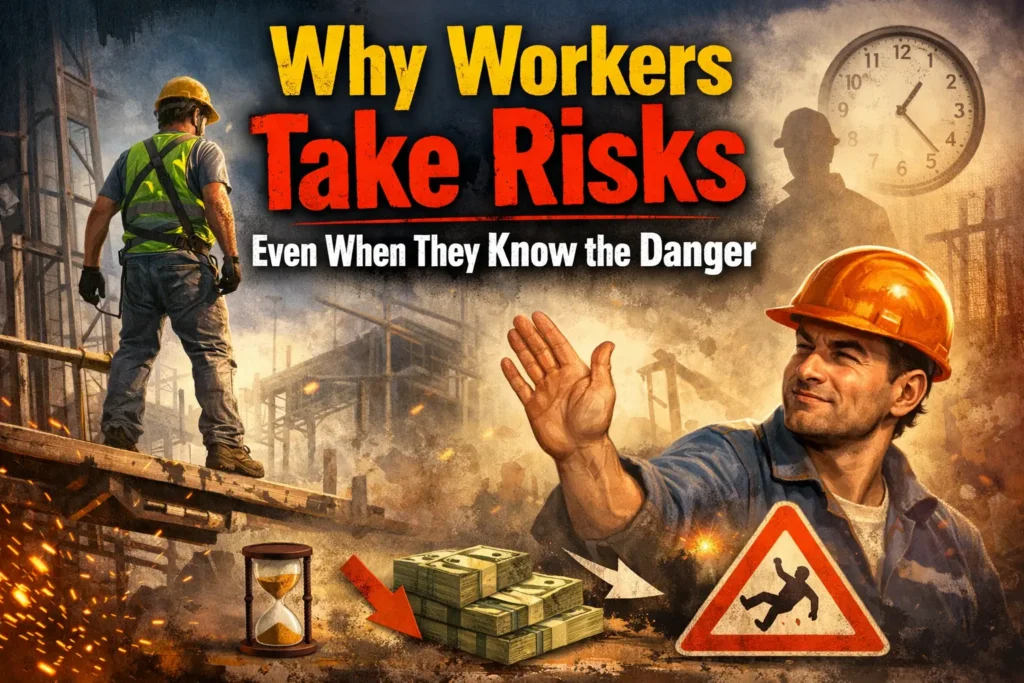
Why Workers Take Risks Even When They Know the Danger
Have you ever seen a worker ignore safety rules even after attending training and knowing the risks? This is one of the biggest paradoxes in workplace safety. Workers are aware of hazards, they understand the consequences, yet they still take risks.
This behavior confuses many safety professionals. If knowledge is there, why does action not follow?
Knowledge vs Action Gap
The answer lies in the gap between knowing and doing. Safety knowledge does not automatically translate into safe behavior. Human decisions are influenced by emotions, habits, pressure, and environment.
Understanding this gap is the first step to solving the problem.
The Psychology Behind Risk-Taking
Human Behavior and Decision Making
Human beings do not always make rational decisions. Even when they know something is dangerous, they may choose convenience, speed, or comfort over safety.
This is not always intentional. It is often influenced by subconscious factors.
Reason 1: Overconfidence and Experience
“Nothing Will Happen to Me” Mindset
Experienced workers often develop overconfidence. They have done the same task many times without incidents, so they believe they can handle the risk.
This mindset leads to ignoring safety procedures.
Reason 2: Time Pressure and Deadlines
Productivity Over Safety
When deadlines are tight, workers feel pressure to complete tasks quickly. Safety measures may be seen as obstacles.
In such situations, speed becomes more important than safety.
Reason 3: Habit and Routine Behavior
Normalization of Risk
Repeated exposure to risk without accidents makes unsafe behavior feel normal. Over time, risky actions become habits.
This is known as normalization of risk.
Reason 4: Peer Pressure
Following Others
Workers often follow what others are doing. If unsafe behavior is common, it becomes accepted.
Peer influence plays a strong role in decision-making.
Reason 5: Lack of Supervision
Behavior Changes When No One Watches
Workers may follow rules when supervisors are present but ignore them when no one is watching.
This shows that behavior is influenced by supervision.
Reason 6: Poor Safety Culture
System Failure
If safety is not valued in the organization, workers do not take it seriously. A weak safety culture leads to risky behavior.
Reason 7: Inadequate Training
Understanding vs Belief
Training may provide knowledge, but it does not always change beliefs. Workers may understand risks but not believe they will be affected.
Reason 8: Comfort and Convenience
Shortcuts
Safety measures sometimes require extra effort. Workers may take shortcuts to save time and energy.
Reason 9: Fear of Job Loss or Pressure
Economic Factors
In some cases, workers take risks because they fear losing their job or facing pressure from supervisors.
Reason 10: Lack of Consequences
No Accountability
If unsafe behavior is not corrected, workers continue doing it. Lack of consequences encourages risk-taking.
Real Example of Risk-Taking Behavior
Lessons Learned
In one case, a worker removed his safety harness while working at height because it was uncomfortable. He knew the risk but chose convenience.
This resulted in a fall and serious injury.
How to Change Risk-Taking Behavior
Practical Strategies
- Improve supervision
- Encourage safe behavior
- Provide practical training
- Remove pressure from workers
- Enforce rules consistently
Role of Safety Officers and Management
Leadership Impact
Safety officers and management must lead by example. Their actions influence worker behavior.
Building a Strong Safety Culture
Long-Term Solution
The best solution is to build a strong safety culture where safe behavior becomes a habit.
Key Takeaways
- Knowledge alone does not change behavior
- Human psychology plays a major role
- Pressure and habits influence decisions
- Safety culture is critical
- Consistent enforcement is necessary
Conclusion
Workers take risks not because they are unaware, but because of human behavior and workplace conditions. Understanding these factors helps safety professionals address the root cause and improve safety performance.
Why Workers Ignore PPE Even After Training
My Honest Advice After Seeing War Impact on Safety Careers
Control Measures for High Risk Construction Work
Site Induction Training Guide for New Workers (Complete Safety Guide)
New Safety Laws Every Company Must Follow
FAQs
1. Why do workers take risks knowingly?
Due to habits, pressure, and overconfidence.
2. Does training solve the problem?
Not always, behavior change requires more than training.
3. What is normalization of risk?
Accepting unsafe behavior as normal.
4. How to reduce risk-taking behavior?
Through supervision, culture, and enforcement.
5. Who is responsible for safety behavior?
Everyone, including workers and management.
